Believe the evidence of your eyes and ears
The Trump Administration is selling you lies on Iran. Plus: courts hit Democrats (and democracy) ahead of the midterms and did the FDA commissioner cave on flavored vapes to save his job?

Here are the week's top news stories:
#1 WAR ON IRAN
On Friday, May 1 — just hours before the deadline to wind down combat operations under the War Powers Resolution — Donald Trump wrote to Congress declaring the war on Iran, known as Operation Epic Fury, effectively over. Two days later, he announced the launch of a "new" U.S. operation called Project Freedom.
Trump said the mission was humanitarian in nature: roughly 20,000 seafarers had been stranded aboard merchant vessels in the Strait of Hormuz for weeks, and his administration would help escort them safely through before they ran out of fuel, food or water.
“If, in any way, this Humanitarian process is interfered with, that interference will, unfortunately, have to be dealt with forcefully,” Trump wrote on Truth Social.
United States Central Command announced the operation would involve 15,000 service members and more than 100 aircraft and naval assets. So, not small.
Secretary of State Marco Rubio and Defense Secretary Pete Hegseth spent much of Monday trying to sell the plan — and convince skeptical reporters that the war was over and this operation was a totally different thing.
By Tuesday evening, the plan had largely collapsed — less than 48 hours after it began. In a post on Truth Social, Trump claimed the mission would — at the request of Pakistan and others — “be paused for a short period of time to see whether or not an Agreement can be finalized and signed.”
Behind the scenes, though, the administration’s haste and disorganization appear to have doomed the mission before it even got underway.
The New York Times reported that shipping companies complained there was too much ambiguity and questioned whether the voyage was worth the risk.
The Wall Street Journal reported that the U.S. hastily assembled the mission without securing commitments from allies.
Another Wall Street Journal report said ships trapped in the strait were effectively “sailing blind” after intense electronic interference rendered navigation systems unusable.
Meanwhile, NBC News reported that Saudi Arabia refused to allow the U.S. to use its bases or airspace for the mission because it had not been properly consulted in advance. “A call between Trump and Saudi Crown Prince Mohammed bin Salman did not resolve the issue,” NBC reported. The White House insisted regional allies had been informed ahead of time.
Mohammad Ghalibaf, Iran's Speaker of Parliament, on X mocked the effort: "Operation Trust Me Bro failed."
Meanwhile, the US and Iran continued to attack each other, each blaming the other for starting it first.
All this played out as the administration continues to be opaque about the war — its goals, its costs and the damage it may already be inflicting on U.S. interests at home and abroad.
The Washington Post 🎁 reported that Iran has caused more damage on U.S. assets in the Middle East than previously disclosed. “Experts who reviewed The Post’s analysis said the damage at the sites suggested that the U.S. military had underestimated Iran’s targeting abilities, not adapted sufficiently to modern drone warfare and left some bases under-protected.”
The Post also reported that U.S. intelligence assessments conclude Iran could withstand a U.S. naval blockade for at least three to four months without severe economic damage — a reality “more sober than the administration’s public statements.”
In Oval Office remarks Wednesday, Trump claimed: “Their missiles are mostly decimated, they have probably 18, 19 percent.” But, according to the analysis, Iran still retains “significant ballistic missile capabilities,” including roughly 75% of its prewar mobile launchers and 70% of its missile stockpile. Iran has reportedly continued producing missiles during the war and still has access to underground weapons facilities despite repeated U.S. and Israeli strikes.
If that intelligence is accurate, it makes a New York Times report published this week even more troubling: the Trump administration has agreed to sell an additional $8 billion in air-defense interceptor missiles and services to Gulf nations including Kuwait, the UAE and Bahrain — despite concern among some Pentagon officials about dwindling U.S. stockpiles after months of war.
Sen. Mark Kelly (D-AZ) told CBS News Sunday that low stockpiles "means the American people are less safe, whether it's a conflict in the western Pacific with China or somewhere else in the world, the munitions are depleted. You may have seen me ask the Secretary of Defense this question about how long it's going to take to replenish. We're talking about years."
Popular Information also reported that the war has cost significantly more than the administration has publicly acknowledged, estimating the price tag at roughly $71.8 billion over the first two months — about $1.2 billion per day. Last month, Pentagon officials initially said the war had cost $25 billion before revising the estimate upward to $50 billion days later.
Perhaps embarrassed by the mission’s public collapse and the sobering investigative reporting, Trump returned to threatening Iran within days – with his incoherent, mad-man rants unbecoming of the president of the United States.
If this all feels crazy and reckless – it's because it is.
After more than two months of war, the Trump administration still has not clearly articulated what its objective is. And if the objective itself remains vague, how can the administration credibly claim anything has been achieved?
And, does anyone really believe an administration that has cut off life-saving food and medicine to millions of vulnerable people around the world — including children — was deeply concerned about stranded merchant vessels and seafarers in the Strait of Hormuz?
A more plausible explanation — based on credible reporting, public statements, and what we can all plainly see and hear — is that the Trump administration underestimated Iran, failed to plan, and then scrambled to justify continuing military operations after already declaring the war over. And when that effort also appeared to collapse, it pivoted again — reframing the pause not as a failure, but as an opening for diplomacy.
All this confusion and obfuscation might be part of their strategy, but more likely – it's the product of an unwell man at America's steering wheel, surrounded by bootlickers – both bright and dumb – who tell him how pretty and smart he is.
#2 ELECTION INTERFERENCE: GERRYMANDERING
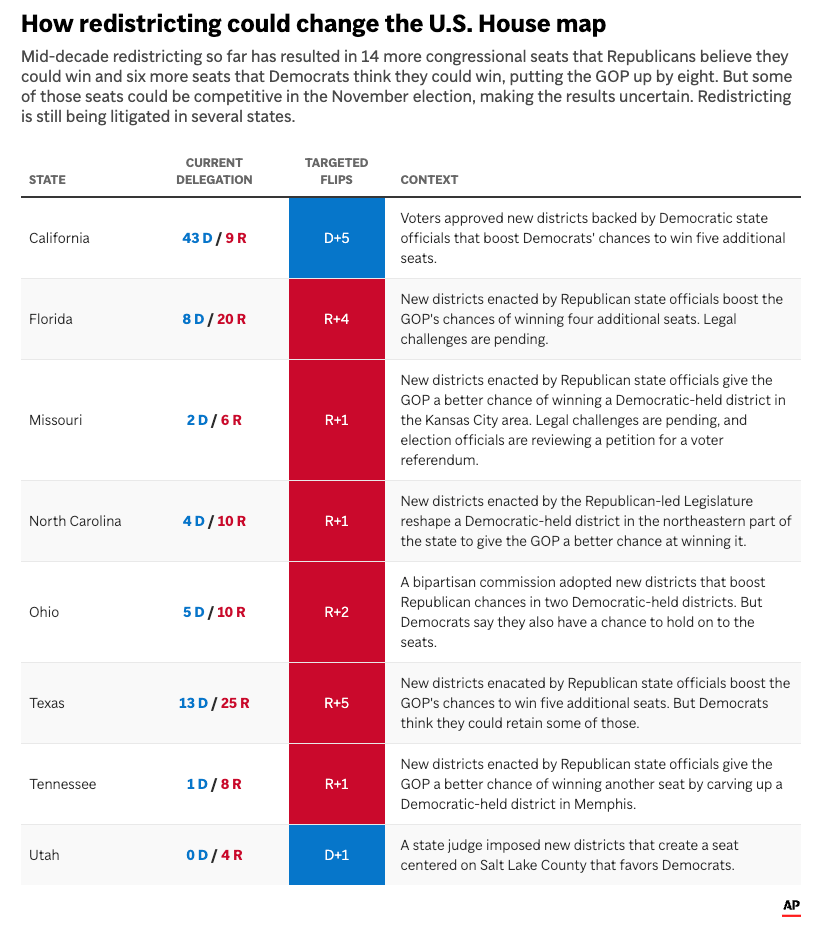
Just as the pendulum seemed to be swinging toward Democrats, two key rulings have plunged the party into deep despair about their prospects of winning the House in November's midterm elections.
- Virginia's Supreme Court ruled 4-3 on Friday to throw out the redistricting amendment voters approved last month. It approved a new congressional map that would have netted Democrats up to four additional seats to help counter a Republican-led campaign to gerrymander districts nationwide ahead of this fall's midterm elections.
- In its opinion, the Court wrote that Democratic lawmakers violated the state constitution because the first legislative vote authorizing the new map occurred days before last fall’s elections — meaning some Virginians cast ballots early without knowing how lawmakers would vote on the proposal.
- Virginia Attorney General Jay Jones said the state is exploring ways to challenge the decision, arguing the process was “timely, constitutionally compliant, and legally sound.”
- But, legal experts say the ruling may be final. "That is because the case involved a challenge to a state law about whether lawmakers had followed rules laid out in the Virginia Constitution, not a question of federal law or the U.S. Constitution," The New York Times reports.
- After the Supreme Court's ruling in Louisiana v. Callais last week that weakened Section 2 of the Voting Rights by ruling that a second Black-majority district in a Louisiana map was an unconstitutional racial gerrymander, four southern states led by Republicans worked feverishly this week to gerrymander their maps ahead of this fall's midterm elections:
- In Tennessee, Republicans passed and Gov. Bill Lee signed a new congressional map Thursday that would effectively kill the state's only Democratic House seat, held by Rep. Steve Cohen.
- "The new map splits the state's last majority-minority U.S. House district in Memphis across three seats as Republicans attempt to flip the last Democratic-held district. Democrats are expected to file a lawsuit over the new map, arguing that Republicans are trying to change the rules too close to the election and that the changes were made based on racial demographics," the Tennessee Lookout reports.
- In Alabama, Attorney General Steve Marshall filed motions Friday asking the Supreme Court to lift an injunction that requires the state to keep using a 2023 congressional map drawn to comply with Section 2 of the Voting Rights Act. That map – used in the 2024 elections – includes two majority-Black districts.
- Gov. Kay Ivey has also signed special election bills into law that would let her hold new primaries if SCOTUS rules in the state's favor. Alabama has asked the Court to rule by May 14 — meaning the districts could be changed five days before the state is scheduled to vote on May 19.
- In Louisiana, Republican legislators presented draft maps Friday targeting one or both of the state's majority-Black districts. Protesters filled the Capitol during the hearings. Voting on a new map could begin as early as this week.
- Gov. Jeff Landry suspended the state's congressional primaries from May 16 to July 15 to give state lawmakers time to redraw the map.
- In South Carolina, the state House approved an amendment to focus on redistricting there.
- "The clear target... is the 6th Congressional District, represented by [Rep. James] Clyburn, once the highest-ranking Black member of Congress. The district is the only Democratic-held congressional seat in the state and has long been a focus of Republican redistricting efforts," Democracy Docket reports.
- In Tennessee, Republicans passed and Gov. Bill Lee signed a new congressional map Thursday that would effectively kill the state's only Democratic House seat, held by Rep. Steve Cohen.
- Also this week:
- In Florida, Gov. Ron DeSantis (R) signed into law a new congressional map Monday that could net Republicans four more seats in November.
- In Indiana, Trump proved it pays to play. Five of the seven state senators who opposed Trump's redistricting push lost their primaries Tuesday to Trump-backed challengers. A sixth, Sen. Spencer Deery, barely survived by three votes.
Put together, this means that not only could Democrats not catch up with Republican gerrymandering efforts – but they could lose several seats they already hold because of the Republican push in these southern states.
So why is it that Republican legislatures can slither back to their state houses and gerrymander to high Heaven and states run by Democrats are losing in courts?
The NYT: "Democrats themselves have grown more ruthless about gerrymandering, but they are broadly struggling to keep up. In part because, years ago, some Democratic-controlled states like Virginia installed independent commissions to oversee their map-drawing processes in an effort to insulate them from politics. Republicans kept the cartographic power in state legislatures, allowing Texas, Florida, North Carolina, and Missouri to enact partisan maps with few logistical hurdles."
"No one can act surprised. This was the predicted outcome of the Supreme Court’s Louisiana v. Callais decision... With the right-wing justices’ blessing, Republican lawmakers can now enact segregationist gerrymandering and reestablish the pre-civil-rights-era status quo ante," writes The Intercept.
#3 HANTAVIRUS OUTBREAK (New)

This is not the usual Fifth material — but given the amount of misinformation, disinformation and fear circulating this week, I thought it would be helpful to cover it.
- The MV Hondius, a cruise ship battling a hantavirus outbreak, arrived Saturday in Tenerife, part of Spain’s Canary Islands. The ship departed in April but soon reported infections linked to the Andes strain of the virus.
- Hantavirus is a rare zoonotic disease spread primarily through contact with bodily fluids from infected rodents. The Andes strain is notable because it is one of the few forms known to spread person-to-person.
- There have been six confirmed and two suspected cases of the virus, according to the World Health Organization (WHO). Three passengers have died so far. Symptomatic passengers were removed from the ship earlier this week.
- At least six asymptomatic Americans disembarked around that time and have since been located for contact tracing, according to the cruise company. NBC News reports those passengers are from Arizona, California, Georgia, Texas and Virginia.
- At least 17 Americans who remained on board – arrived with the ship on Saturday. None are currently known to be symptomatic, though they will be quarantined at the National Quarantine Unit at the University of Nebraska Medical Center in Omaha.
- According to the center, it is “the only federally funded quarantine unit in the United States, designed specifically to safely house and monitor people who may have been exposed to high-consequence infectious diseases.” The facility treated patients during the 2014 Ebola outbreak and cared for some of the first Americans diagnosed with COVID-19 in 2020.
- The WHO says the risk to the general public remains low.
- Thanks, WHO! A UN agency created to serve the public health and good which the US promptly withdrew from after Trump took office! Well, we have the CDC, at least!
- Oh wait, where is the CDC? As the AP points out, it was largely absent. “No quick dispatching of disease investigators. No televised news conference to inform the public. No timely health alerts to doctors.”
- The internet was also rife with conspiracy theories. No passenger videos flooding social media? It must be made up! The government is hiding another COVID virus!
- No. There were literally, like, 90 passengers on board. It was not a Carnival Cruise with thousands island hopping. It was a weeks-long voyage TO BIRD WATCH, probably older-ish people worried and tired and who don't live their lives on social media. (I have grown quite fond of bird watching in my old age, so this is not a knock. I am also worried and tired, so also, not a knock).
- But, who could blame people for being freaked out? Until Friday, it was mostly Trump telling reporters: “We seem to have thing under very good control.” 😳 That was also the day the CDC issued its first press release.
- By Saturday, CDC officials were speaking to reporters but said they could not be quoted by name, they said, “under rules set by aides to Health Secretary Robert F. Kennedy Jr.” They also declined to answer whether the American passengers would be free to leave the Nebraska facility voluntarily. 😳
- Dr. Jeanne Marrazzo, CEO of the Infectious Diseases Society of America: “The hantavirus outbreak is ‘a sentinel event’ that speaks to ‘how well the country is prepared for a disease threat. And right now, I’m very sorry to say that we are not prepared.'"
- While Israel has violated the Lebanon ceasefire almost daily over the past month, it escalated further this week by striking a densely populated suburb of Beirut. Under the ceasefire agreement — which did not include Hezbollah, the group Israel is actually fighting — Israel agreed to conduct only defensive operations. The Beirut strike was offensive in nature and targeted what Israel said was a Hezbollah operative.
- On Saturday alone, Israeli forces killed 36 people in Lebanon and wounded another 74, Haaretz reports.
- At least 2,846 people have been killed since the war began, according to local officials, including 552 since the so-called ceasefire. An estimated 1.2 million people remain displaced inside Lebanon because of the war.
- The Supreme Court temporarily lifted a lower-court ban on mailing prescriptions for mifepristone, a medication commonly used in abortions. Justice Samuel Alito signed the emergency order while the case proceeds.
- Trump is expected to fire FDA Commissioner Marty Makary, Politico reports, amid frustration from parts of MAGA world that he has “alienated a range of HHS officials and interest groups, including anti-abortion activists, opponents of vaping regulation and some drug manufacturers.”
- Earlier this week, The Wall Street Journal reported Trump was furious Makary was not moving fast enough to approve fruit-flavored vaping products. Within days, the FDA authorized the nicotine products — the first such approvals in the agency’s history. Makary had reportedly resisted, citing concerns the flavors appeal to children and teenagers.
- Senate Republicans want taxpayers to spend $1 billion on security infrastructure connected to Trump’s planned $400 million White House ballroom project. Sen. Chuck Grassley inserted the funding request into a reconciliation bill, claiming it would pay for security upgrades rather than the ballroom itself.
- FBI Director Kash Patel is reportedly ordering polygraphs for staff and IT employees and avoiding meetings after a wave of negative press coverage, MS NOW reports. The FBI declined to comment on the polygraphs but denied Patel is avoiding his team.
- The DOJ is trying to wipe out the $83.3 million defamation judgment Trump owes writer E. Jean Carroll, who successfully sued him after he publicly denied her allegation that he sexually assaulted her in a Manhattan department store in the 1990s. Politico | AP | Stay of mandate (PDF)
- Rep. Chuck Edwards (R-NC) is being investigated by the House Ethics Committee for allegedly having an improper relationship with a subordinate and harassing staff, Politico reports. Edwards denies the claims.
- Rep. Nancy Mace (R-SC) released documents showing Congress used more than $338,000 in taxpayer funds to settle harassment claims against at least six former lawmakers between 2004 and 2018.
- Transportation Secretary Sean Duffy spent seven months filming a five-part road trip for America's 250th paid for by companies he regulates. The nonprofit that funded it lists Boeing, United Airlines, Shell, and Toyota as sponsors. Duffy says he won't take royalties.
- A federal judge released a suicide note allegedly written by Jeffrey Epstein that was reportedly found by his cellmate after an earlier apparent suicide attempt and remained sealed until The New York Times petitioned the court to unseal it.
- Commerce Secretary Howard Lutnick testified behind closed doors before the House Oversight Committee for more than four hours about his ties to Epstein.
- Ukraine and Russia agreed to a three-day ceasefire and prisoner exchange running from Saturday through Monday, President Trump said on Truth Social. By Saturday, Russia had already killed three people in violation of the ceasefire, Al Jazeera reports.
- The State Department says it will begin revoking passports of any Americans who have a "significant" amount of unpaid child support.
COMING UP
Monday, May 11: Justice Alito's temporary stay expires and SCOTUS is expected to decide whether mail-order mifepristone stays legal while Louisiana v. FDA proceeds.
Thursday, May 14 - Friday, May 15: Israeli and Lebanese officials meet in DC to discuss extending the ceasefire deal and President Trump is in China.
May 14: SCOTUS deadline to rule on Alabama's map
May 16: Louisiana Senate primary
Are you enjoying The Fifth? Please consider sharing it with a friend!
Have suggestions, feedback, questions? Email me at huma@fromthefifth.com