How to Dismantle a Democracy, Part Deux
Plus: Epstein fallout goes global. Bezos guts the Post. And the Wyden Siren goes off.
#1: How to Dismantle a Democracy
Concerns that President Trump and his administration are working to undermine future elections reached a new threshold this week. What once may have been dismissible as bluster is now taking shape as something more coordinated — an effort that touches federal law enforcement, intelligence agencies, Congress, and the courts. This week:
- Trump called for nationalizing elections. The president said openly that "the Republicans ought to nationalize the voting," claiming he won states "that show I didn't win." This is a lie. State audits and independent studies have consistently shown that voter fraud is exceedingly rare and has never altered the outcome of an election. More importantly, Article I of the Constitution gives states — not the president — control over election mechanics: voter registration, ballot counting, and fraud prevention. Just last week, federal judge Colleen Kollar-Kotelly blocked a Trump executive order requiring proof of citizenship to vote, writing that "our Constitution does not allow the President to impose unilateral changes to federal election procedures."
- The backlash to Trump's comments was bipartisan. Senate Majority Leader John Thune (R-SD) said he is "not in favor of federalizing elections." Sen. Mark Warner (D-VA) warned of a "coordinated" attempt to "interfere" in the midterms. West Virginia's Republican secretary of state pushed back. But House Speaker Mike Johnson offered something closer to cover — echoing Trump's debunked claim that Republican candidates in California recently saw leads "magically whittled away," allegations county election officials have directly refuted. Johnson later admitted he has no proof.
- Reuters reported this week that the Office of the DNI seized voting machines from Puerto Rico last year, ostensibly to test for Venezuelan interference. No credible evidence of such interference was found.
- Meanwhile, Fulton County, Georgia is suing to recover 656 boxes of 2020 election materials the FBI seized in late January — despite three recounts having already validated the results. DNI Tulsi Gabbard was present for that raid, and no one can agree on why. Gabbard initially said Trump sent her. Trump said he had no idea. Then he said it was AG Pam Bondi. By week's end, Gabbard claimed it was both.
- Steve Bannon said the quiet part out loud. On his podcast, Trump's former advisor declared: "We're going to have ICE surround the polls come November," and called for invoking the Insurrection Act to deploy the 82nd and 101st Airborne to polling places. Federal law prohibits voter intimidation.
- Why this matters beyond the headlines. State election officials are bracing — and they're increasingly on their own. CISA's information-sharing programs, the federal government's primary channel for alerting states to cyberattacks, were shut down last year with no replacement. Maine's secretary of state noted there was no federal situation room on Election Day for the first time in years — officials learned about bomb threats from the news. Minnesota's secretary of state said he feels "a responsibility to plan for" federal interference. Arizona's top election official put it plainly: "The bad guys are inside the castle."
- Election lawyer Marc Elias outlined two scenarios to watch. Before the midterms: the administration seeks access to the nationwide voter file, giving it leverage to pressure states into purging rolls. After the midterms: the FBI seizes ballots in close races — exactly what happened in Fulton County. These are not hypothetical scenarios. They're happening now, happened before, and may happen again.
#2: The Epstein Files
The DOJ released approximately 3.5 million pages of Epstein-related documents on January 30, pursuant to the Epstein Files Transparency Act signed by Trump last November. The fallout has been swift, global, and far from over. Here's who got named this week — and what happened next.
- Brad Karp, chairman of Paul Weiss, one of the most powerful corporate law firms in the country, resigned this week after dozens of email exchanges with Epstein surfaced — spanning at least 2015 through 2019. The emails showed Karp asked Epstein for help getting his son a job on a Woody Allen film and assisted Epstein with negotiations on his sex trafficking plea deal. He stepped down as chairman but remains a partner at the firm.
- Peter Mandelson, the UK's newly appointed ambassador to the United States, was exposed as having a far deeper relationship with Epstein than previously known — including allegations he may have leaked market-sensitive financial information to Epstein during the 2008 financial crisis. Mandelson maintained the relationship even after Epstein served time for soliciting prostitution from a minor. UK Prime Minister Keir Starmer publicly apologized to Epstein's victims, saying he was "sorry for having believed Mandelson's lies and appointing him." London's Metropolitan Police have opened an investigation into potential misconduct in public office — a charge that carries a possible life sentence.
- Noam Chomsky, long regarded as one of the foremost public intellectuals of the left, exchanged emails with Epstein in 2019 — after sex trafficking allegations were public. Chomsky urged Epstein to ignore the press and avoid media "vultures." The files also indicate Epstein was advising Chomsky on financial matters, with a disputed payment of over $180,000 referenced. There is no indication of criminal involvement, but the moral failure is staggering for a man who built his legacy on speaking truth to power.
- Peter Attia, the popular longevity doctor and podcaster, was mentioned more than 1,800 times in the files. Emails revealed friendly and salacious correspondence with Epstein from 2014 to 2019, with Attia visiting Epstein's New York home roughly seven to eight times. The fallout was immediate: CBS pulled a scheduled "60 Minutes" segment, AG1 removed him from its advisory board, and he stepped down from David Protein. Attia says he was never involved in criminal activity.
- The Clintons resurfaced as well. The files include frequent email communications between Ghislaine Maxwell and Clinton staffers from 2001 to 2004, and Bill Clinton traveled on Epstein's plane at least 16 times. No victims have publicly accused Clinton of crimes. Both Bill and Hillary Clinton have agreed to appear before a congressional committee — depositions are scheduled for February 26 and 27. Hillary is pushing for a public hearing instead.
- And then there's Norman Finkelstein. The political scientist and longtime critic of power appears in the files — but not the way everyone else does. When academic Robert Trivers tried to connect Finkelstein with Epstein, Finkelstein fired back by quoting Epstein's victims and writing that Epstein and Alan Dershowitz deserve to be "throttled." He rejected the overture completely. In a document dump full of complicity and moral cowardice, Finkelstein may be the only person whose reputation improved.
#3: Democracy Dies in Daylight
The mainstream media has failed the American public in ways that are hard to overstate: an addiction to anonymous sourcing, an allergy to calling things what they are, and a reflex for both-sidesing everything into mush. But legacy journalism still plays a critical role in upholding the freedoms we hold dear: rigorous fact-checking and verification, the resources to take on people in power, and dogged investigative reporters who know where to dig. That infrastructure took a devastating hit this week.
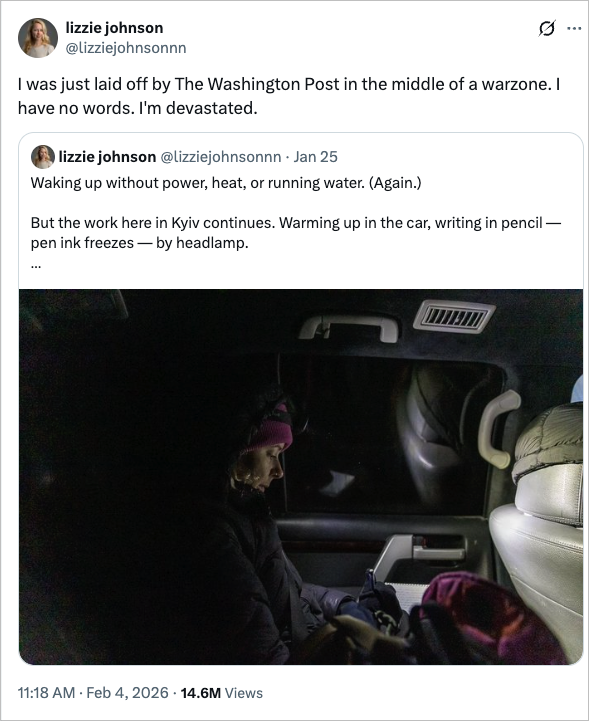
- Jeff Bezos's Washington Post laid off hundreds of journalists — roughly one-third of the newsroom. Entire beats were eliminated: the Middle East desk, the sports section, the books section, every staff photographer. A reporter covering the war in Ukraine was let go. Another already in Italy for the Olympics was sent home.
- Post executives framed the layoffs as financial necessity. But the math ain't mathing. Former Post fact-checker Glenn Kessler pointed out that "even if the losses are still around $100 million a year," Bezos — worth roughly $200 billion — "would have to close the place in…2,500 years." Meanwhile, Amazon just spent $75 million buying and promoting a documentary about Melania Trump. Kessler argues that Bezos could absorb the cost during Trump's first term, but with Elon Musk — his chief rival in the space business — now firmly in Trump's orbit, the calculation changed.
- Why it matters: One of the country's most important newsrooms enters the most consequential election year in a generation with fewer reporters covering the people in power.
#4: Where Things Stand in Minneapolis
DHS announced this week it would pull 700 federal agents from Minneapolis. But 2,300 remain — a 4-to-1 ratio to Minneapolis police officers. In an NBC interview on February 4, Trump said he learned that "maybe we could use a little bit of a softer touch," while insisting "you still have to be tough."
- The investigation into the killing of Renée Good — the American citizen shot by ICE agent Jonathan Ross on January 7 — escalated this week. Minnesota state prosecutors formally demanded evidence from the Trump administration. The FBI, under orders that reportedly came through Director Kash Patel, refused to cooperate and halted its own civil rights investigation into the shooting. Several career federal prosecutors resigned in protest. Good's brothers testified before Congress, with Luke Ganger telling lawmakers: "What a beautiful American we have lost."
- An AP investigation reveals that, in January, ICE agents beat Alberto Castañeda Mondragón so severely during an arrest outside a St. Paul shopping center that he suffered eight skull fractures and five brain hemorrhages. Hospital staff said his injuries contradicted ICE's claim that he "ran into a wall."
- Five-year-old Liam Ramos was released from CBP custody this week by court order — only for the administration to immediately file for his family's expedited deportation despite their legal asylum status.
- A federal judge ordered ICE to stop using tear gas on protestors and journalists in Portland. Several states are now moving to bar local law enforcement from assisting federal agents.
- And in Washington, lawmakers avoided a government shutdown this week by agreeing to fund the government for another two weeks — an extension that expires Friday, with immigration enforcement funding at the center of the stalemate.
The Wyden Siren
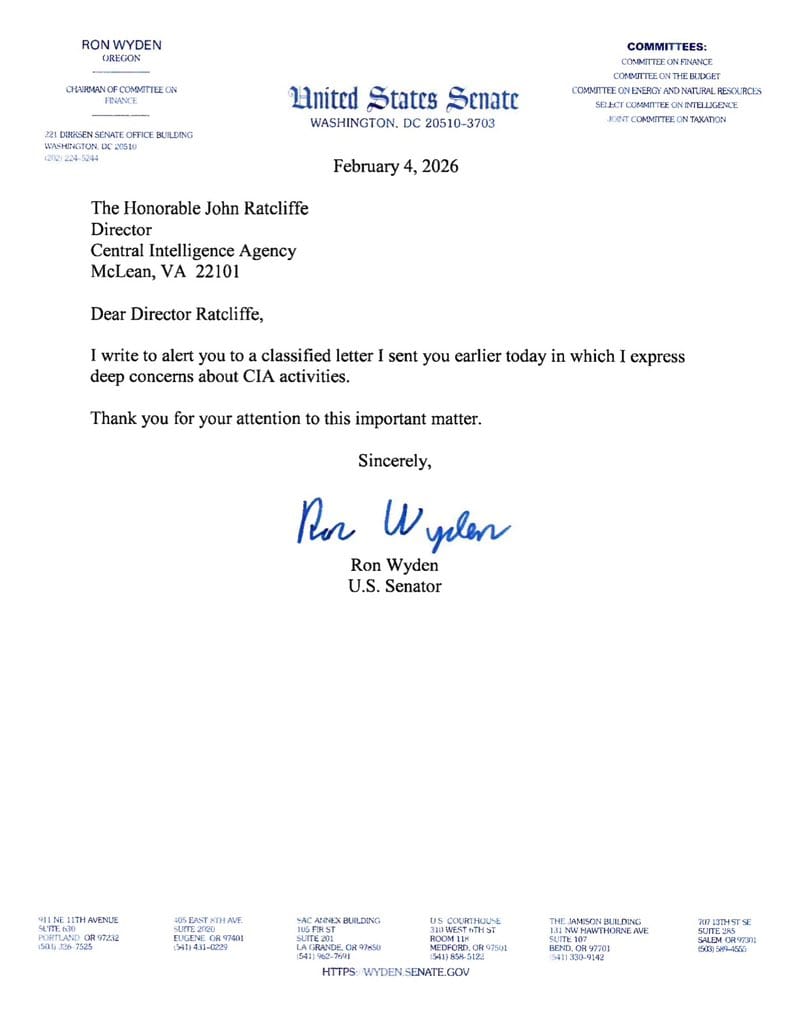
Sen. Ron Wyden (D-OR), the longest-serving member of the Senate Intelligence Committee, sent a two-sentence letter to CIA Director John Ratcliffe this week: "I write to alert you to a classified letter I sent you earlier today, in which I express deep concerns about CIA activities. Thank you for your attention to this important matter."
Intelligence watchers call this the "Wyden Siren." He's done it before — vague public notes signaling something classified is deeply wrong — and every time, he's been proven right. In 2011, he warned of a "secret interpretation" of the Patriot Act. Snowden proved him right. Sen. Mark Warner said he "shares many of the concerns." The CIA called Wyden's alarm a "badge of honor." We don't know what this is about yet. Wyden's track record says we will. (EDITED: Updated incorrect links)
DEVELOPING- Trump Posts Racist Video of the Obamas, Deletes It, Refuses to Apologize: Trump shared a video on Truth Social depicting Barack and Michelle Obama as apes. It stayed up roughly 12 hours before the White House decided to take it down. Trump blamed a staffer and said "I didn't make a mistake." Multiple Republican lawmakers condemned it. (CNN | Washington Post | CBS News)
- Kennedy Claims Keto Can "Cure" Schizophrenia: HHS Secretary Robert F. Kennedy Jr. claimed a ketogenic diet can "cure" schizophrenia and bipolar disorder. The Harvard psychiatrist he cited, Dr. Christopher Palmer, immediately responded that he has "never claimed to have cured schizophrenia." (NYT)
- TrumpRx: The Prescription Drug Website That Doesn't Do What It Claims: The Trump administration launched TrumpRx.gov promising massive drug discounts — but the site simply redirects users to existing manufacturer hardship programs anyone can already access. (New Republic)
- Trump Wants to Name Penn Station and Dulles Airport After Himself: The president is withholding federal funding — already approved by Congress — from tunnel projects in New York and New Jersey unless Sen. Chuck Schumer agrees to name Penn Station and Dulles Airport after him. Both states have sued the administration to release the funding, which was set to run out Friday and could lay off thousands of construction workers. Trump also wants an arch in Washington and a Columbus statue. (Punchbowl | NBC News)
- Public Health Workers Quitting Over Guantanamo Assignments: Nearly 400 U.S. Public Health Service officers have been deployed to ICE detention facilities including Guantanamo Bay. They report life-threatening delays in care, overcrowding, and being asked to facilitate what they describe as inhumane conditions. At least half of those interviewed are leaving or planning to. (Wired)
- The Supreme Court allowed California to use a voter-approved redistricting map that could give Democrats up to five additional House seats in 2026 — a significant boost to their path to a majority. Republicans challenged it as racial gerrymandering; a lower court found it was partisan, not racial. No dissents. (NPR)
- Democrat Christian Menefee won a special election runoff for Texas' 18th Congressional District — the seat left vacant after the death of Rep. Sylvester Turner. The House now stands at 218 Republicans to 214 Democrats, meaning Speaker Johnson can afford to lose exactly one vote on party-line bills. (PBS)
- Trump announced the Kennedy Center will close in July for a two-year "renovation." The timing is conspicuous: since Trump's name was added to the building in December, major artists including Philip Glass and the Washington National Opera have pulled out. (Washington Post)
- Researchers who made up Human Rights Watch's Israel-Palestine team resigned after the organization's leadership blocked a report that deemed Israel's denial of Palestinian right of return "crimes against humanity." (The Guardian)
WHAT TO WATCH: Feb 8–13
- Tuesday, Feb 10: The House Homeland Security Committee will question acting ICE Director Todd Lyons, CBP Commissioner Rodney Scott, and USCIS Director Joseph Edlow — the first major congressional hearing on immigration enforcement since Minneapolis. (House Homeland Security Committee)
- Wednesday, Feb 11: Israeli PM Benjamin Netanyahu meets with Trump to discuss Iran, including potential military action and ballistic missile limits. This comes days after the U.S. shot down an Iranian drone near an aircraft carrier, and Iran warned it would strike U.S. bases if attacked. (Reuters)
- Feb 25: The FBI invited top election officials nationwide to a call about "preparations" for the 2026 midterms. (Axios Denver)
- Also watching: A federal court ordered Elon Musk and State Department officials to sit for depositions over the dismantling of USAID. (Newsweek)