US & Israel Take Us to War, Assassinate Iran's Supreme Leader
The world's tightest BFFs have thrown the entire world into chaos. And for what?
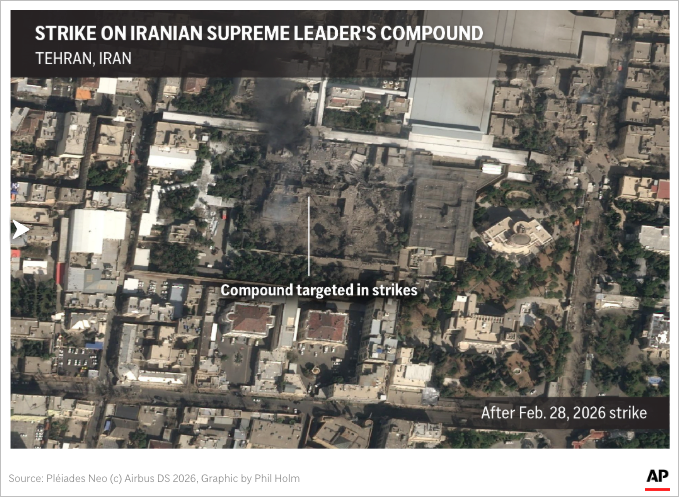
Iran has confirmed that U.S. and Israeli strikes killed the country’s Supreme Leader, Ayatollah Ali Khamenei, on Saturday — less than 24 hours after the two nations launched a joint, coordinated, unprovoked, and illegal attack.
We knew this was coming. That doesn’t make it any easier to process — especially if you’re old enough to remember this country’s disastrous march into war in Iraq and everything that followed. (PS. We still owe the Dixie Chicks an apology.)
#1 Trump & Netanyahu Start War with Iran (2 weeks in a row)
If you're just catching up, I'll start with updates on what's happened as of Saturday evening (roughly 7pm ET) before we get into analysis and additional context.
- The US and Israel on Saturday attacked Iran at 9:27 AM local time (overnight in the US). Both countries say this was a coordinated, planned attack. Joint strikes are ongoing.
- Iran has retaliated, hitting several US and Israeli targets in the Middle East. Iranian news agency Fars reports that US military bases in Qatar, Kuwait, UAE and Bahrain have been attacked. Al Jazeera reports that explosions were heard in Saudi Arabia and bases were reportedly attacked in Jordan.
- In an address posted to social media overnight, President Trump characterized the strikes as "major combat operations" and warned of American casualties. "The lives of courageous American heroes may be lost and we may have casualties. That often happens in war. But we're doing this, not for now. We're doing this for the future, and it is a noble mission."
- Trump said the goal of the attacks is regime change and destroying Iran's nuclear capabilities (even though he has repeatedly claimed the US "obliterated" that last June). He urged Iranians to topple the regime: "When we are finished, take over your government. It will be yours to take. This will be, probably, your only chance for generations."
- Israeli Prime Minister Benjamin Netanyahu called Iran an "existential" threat to Israel and the world. Fun fact: Israel remains the only country in the Middle East known to possess nuclear weapons. Israel hit 500 targets in what was Israel's "largest military flyover in its air force's history."
- Iranian state TV reports at least 201 dead and 747 injured. One of the most horrific reports: a girl's school was hit, killing around 100 children, according to Iranian officials. The US said it was not "aware of reports" of the strike and is "looking into" it. The US denied it intentionally targets civilians.
How We Got Here
- An Illegal, Unprovoked War. As is the habit of legacy media, they take whatever Israel or US officials say and make that the headline. As experts on the region like Assal Rad say: "'Israel says' is not journalism." While Israel and the US call this a "preemptive" attack, it is unprovoked and illegal. The president must seek the approval of Congress to go to war.
- Negotiation Antics. Iran and the US had been engaged in negotiations for weeks to curb Iran's nuclear program. On Friday, Oman's foreign minister Badr Albusaidi, who was mediating those negotiations, told CBS News that — in a sign of progress — Iran had offered to give up its uranium stockpile and allow in weapons inspectors. A fourth round of talks was scheduled for Monday. But it now looks like the Trump administration had already made up its mind.
- Government Claims. Under the Constitution, only Congress can declare war. A president may act without approval in limited cases if there is an imminent threat — but must notify Congress within 48 hours. Trump didn't ask. He took another route.
- European officials, international weapons monitors, and intelligence sources told The New York Times this week that Trump "exaggerated the immediacy of the threat" from Iran. One source said analysts were concerned that "intelligence was being selectively presented or distorted."
- Among the claims the Trump Administration is making:
- Iran has restarted its nuclear program. There is evidence Iran has begun work on rebuilding nuclear facilities, but there is no evidence they are enriching uranium again or trying to build a bomb. According to the International Atomic Energy Agency, most of Iran's nearly 1,000 pounds of 60 percent enriched uranium is buried at Isfahan – one of the sites the US and Israel attacked last year – and there is little evidence the Iranians are digging out the containers in which it is stored.
- Iran has enough nuclear material to build a bomb within "days." Last weekend, Middle East envoy Steve Witkoff claimed Iran was "a week away from having industrial-grade bomb-making material." But Secretary of State Marco Rubio told reporters this week: "They're not enriching right now, but they're trying to get to the point where they ultimately can." And remember — in his remarks after the strikes began, Trump said: "We're doing this for the future." (So is Iran an imminent threat or a future one?)
- Iran is developing long-range missiles that can reach the US. In his State of the Union speech on Tuesday, Trump claimed Iran would "soon" have missiles that can reach the US. Iran has short and medium ballistic missiles that can reach Israeli and American military bases in the Middle East — but it is years away from developing intercontinental capability. The Pentagon's own Defense Intelligence Agency concluded Iran would have long-range capability by 2035 at the earliest — if they "decide to pursue the capability." Iran has shown no interest in doing so.
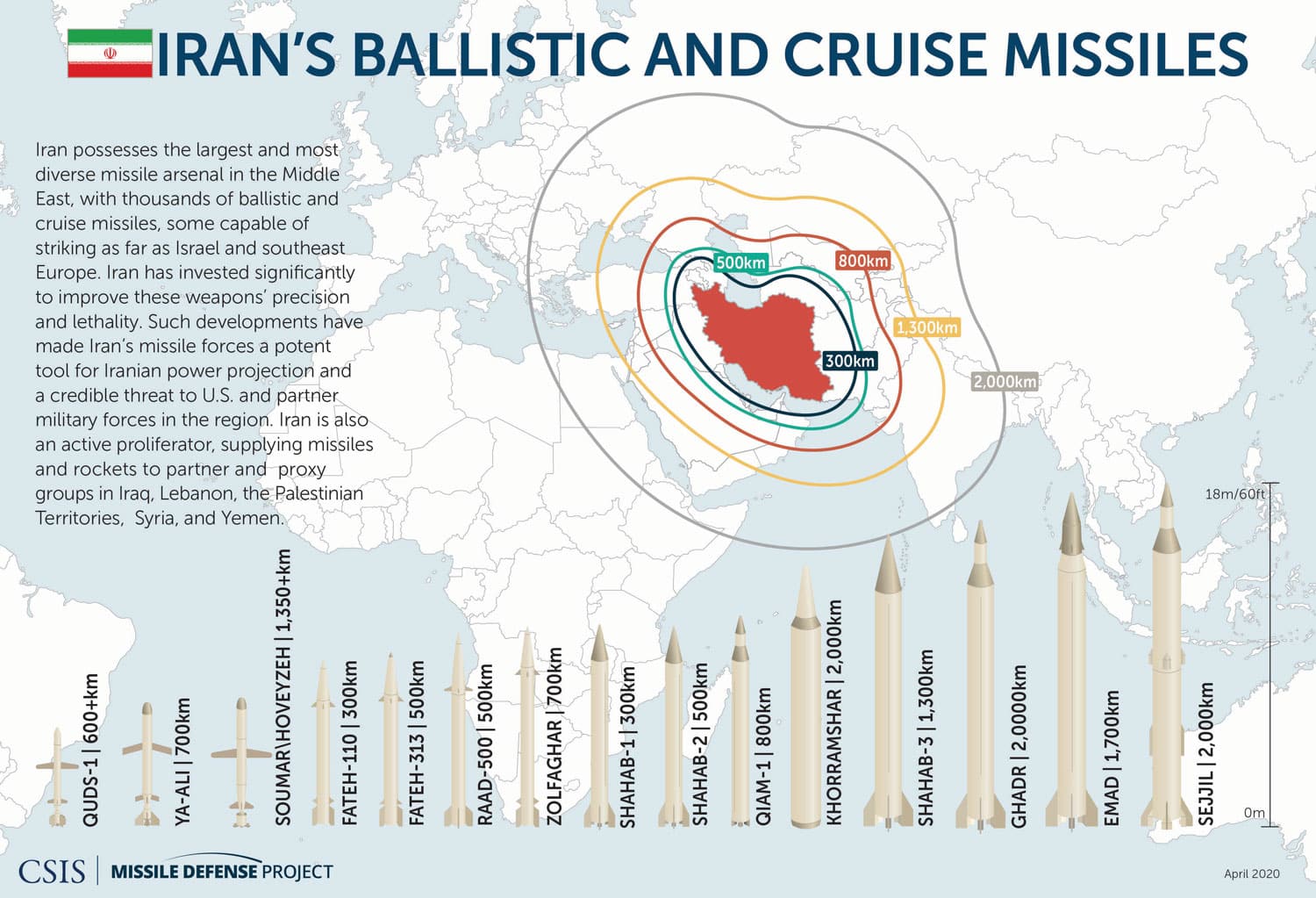
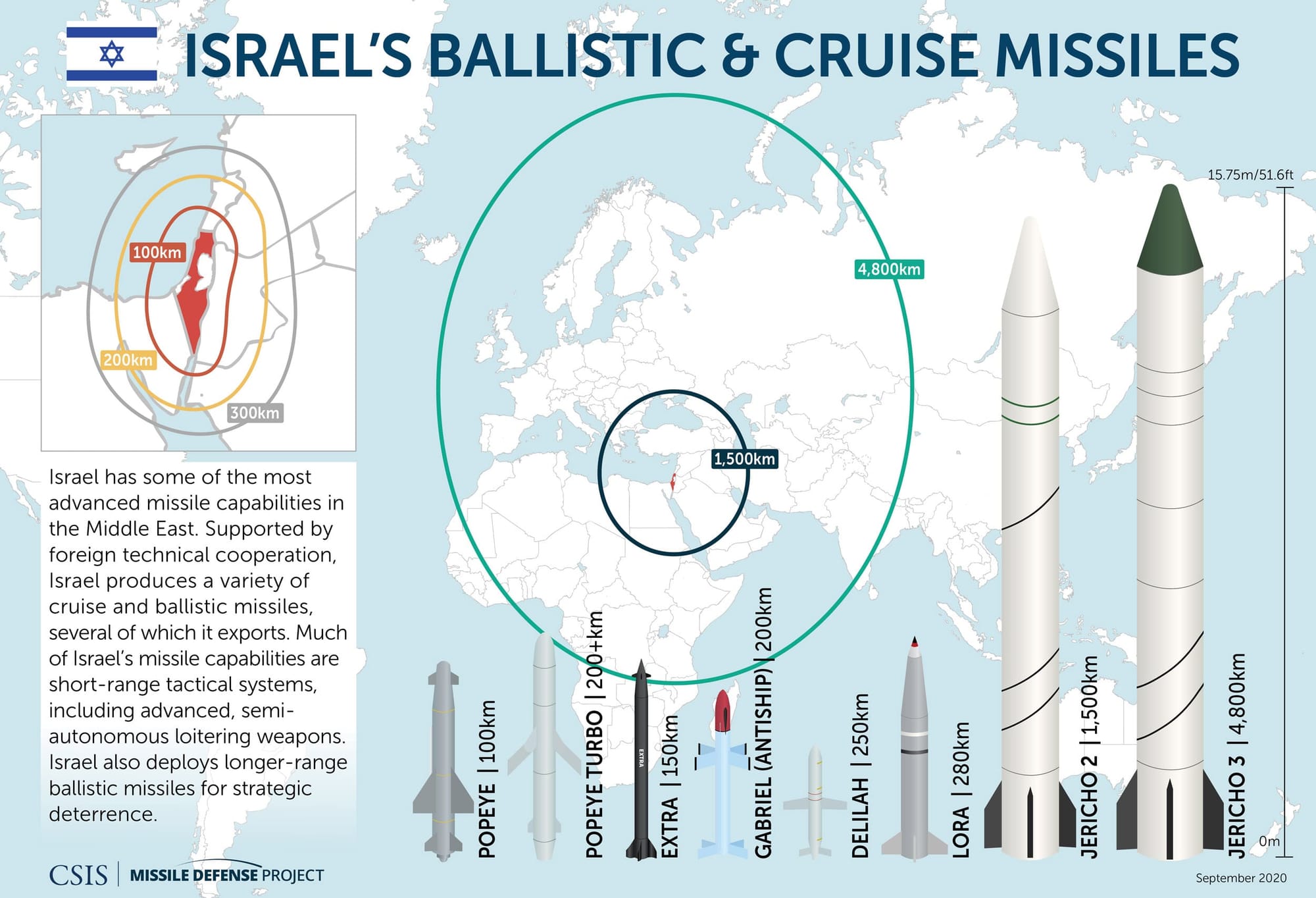
Compare and contrast. Iran isn't nearly as powerful as Israel wants you to think.
- Israel Needed This — and Couldn't Do It Alone. Israel has long considered Iran its primary existential threat — not because of an imminent nuclear weapon, but because Iran funds Hezbollah, supports Hamas, and is the last major regional counterweight to Israeli military dominance. But Israel cannot take on Iran alone. Its air force doesn't have the range, the refueling capacity, or the bunker-busting munitions needed to reach Iran's deeply buried facilities without American support. This was always going to require the US.
- For Netanyahu, the calculus is also personal. He's facing domestic pressure, ongoing corruption trials, and the political fallout of the Gaza war. He is wanted by the International Criminal Court for war crimes. A broader conflict with Iran — framed as existential — consolidates his base and makes him indispensable.
- This isn't new. In 2002, Netanyahu testified before Congress and told lawmakers: "If you take out Saddam, I guarantee you that it will have enormous positive reverberations on the region." He pushed hard for the US invasion of Iraq, promising it would transform the Middle East. Twenty years, trillions of dollars, and hundreds of thousands of lives later, Iraq remains unstable, ISIS emerged from the wreckage, and Iran's influence in the region grew. Now he's making the same argument about Iran.
- The US is not simply "coordinating" with Israel. It is providing the military infrastructure — carrier strike groups, aerial refueling, intelligence, and munitions — that makes this operation possible. (Just like the genocide in Gaza).
- Trump Was Warned. Prior to the attacks, Reuters reports that the president was warned this route meant a high risk of US casualties. Those advisors also suggested the plan could start a "generational shift in the Middle East in favor of US interests." (I'll take "Things Netanyahu Might Say to Get Trump to Fight His Wars" for $600)
- In addition to casualties, The Washington Post reported that Gen. Dan Caine, chairman of the Joint Chiefs of Staff, warned Trump about a depleted US munitions stockpile from supporting Israel and Ukraine, the complexity of an Iran campaign, and the difficulty of operating without allied support.
- Trump Wanted War Anyway? Yale historian Timothy Snyder argues the military logic doesn't hold up: missiles don't produce the political outcomes Washington claims to want. The US has spent over $7 billion bombing Yemen and couldn't dislodge even the Houthis — a weak, unpopular, poorly armed militia. Air wars have a poor track record of overthrowing governments.
- Snyder raises a darker question: whether the purpose of this conflict is less about Iran and more about domestic politics — creating the conditions for Trump to invoke emergency powers around the 2026 midterms. Foreign wars have historically given presidents room to consolidate power at home. (For more on why the timing of this war matters domestically, see #2: Election Interference.)
- Iran's Long Game. In previous conflicts, Iran worked to de-escalate — launching symbolic retaliatory strikes that showed aggression wouldn't go unanswered without exacerbating the situation. This time is different. Iran continued to claim it didn't want war but warned that any attacks would be met with full force. Supreme Leader Ali Khamenei said Iran would attack the US "so hard that it cannot get up again."
- Historical Context. This isn't the first time the US has tried to change Iran's government. Seventy-three years ago, in 1953, the CIA orchestrated a coup against Iran's democratically elected Prime Minister Mohammad Mosaddegh — overthrowing him after he nationalized the country's oil industry. The coup installed Shah Mohammad Reza Pahlavi, whose authoritarian rule lasted until the 1979 revolution that brought the current Islamic Republic to power.
Why It Matters. Well, first – it's plain wrong. I promise you we all want to live in a world where rules – especially those around bombing other countries – mean something.
- Secondly, a conflict with Iran touches every American who drives a car or has a relative in the military. Oil prices have already risen nearly $10 per barrel since tensions escalated, hovering above $66. If the Strait of Hormuz is disrupted — the 21-mile-wide chokepoint off Iran's coast through which nearly 20 million barrels of oil pass every day, roughly one-fifth of global supply — prices could exceed $100, potentially sending gasoline toward $5 per gallon.
- The military buildup alone has already cost an estimated $350–$370 million since late December. Maintaining two carrier strike groups in the region runs about $1 billion per year.
#2 ELECTION INTERFERENCE (⬆️ from #4)
Trump is still at it.
On Wednesday, The Washington Post reported that a group of right-wing election activists has been coordinating with the White House on a draft executive order that would declare a national emergency and give the president federal control over the 2026 midterm elections.
- Foreign Interference. On Thursday, Democracy Docket published the full 17-page draft. The order cites Chinese interference in the 2020 election as the legal basis for a national emergency — and uses that emergency to require hand-marked and hand-counted paper ballots, force all voters to re-register with proof of citizenship, restrict mail-in voting, and authorize the DOJ, USCIS, the Social Security Administration, and the Postal Service to determine who is and isn't an eligible voter. The draft was written by Peter Ticktin, a Florida attorney, and dated April 2025 — meaning this has been in the works for nearly a year.
- Deny, Deny, Deny. Asked about the scheme on Thursday, Trump said: "No. I've never heard about it. Who told you that?"
- Can he actually do this? No. The Constitution assigns authority over elections to Congress and the states — not the president. Marc Elias, the election law attorney who runs Democracy Docket, published the legal memo behind the draft EO and called it "laughable." Ticktin's memo relies on the National Emergencies Act and the International Emergency Economic Powers Act — IEEPA — arguing that IEEPA gives the president authority to address "unusual and extraordinary threats" originating outside the United States. That's the law presidents use to freeze oligarchs' assets and sanction drug cartels. (And the same authority Trump used to impose tariffs — before the Supreme Court said no.) It says nothing about elections.
- Here's why the IEEPA citation matters: IEEPA requires a foreign threat. The draft EO already cites Chinese interference in 2020. And on Saturday — the same day he launched strikes on Iran — Trump posted an article on Truth Social referencing the Biden DOJ's prosecution of three members of Iran's Islamic Revolutionary Guard Corps for hacking his previous campaign's emails and sending information to news outlets. IEEPA needs a foreign enemy. He's now publicly naming two and bombing one of them.
- Related: Georgia's voter purge — which Democracy Docket flagged this week — runs the same playbook at the state level. Secretary of State Brad Raffensperger recently oversaw a purge of 471,000 voter registrations — 6% of the state's electorate. Several organizations have filed suit, claiming the state violated the National Voter Registration Act, which requires officials to make purge-related records public for transparency.
#3 AI AND THE DOD (NEW)
OpenAI CEO Sam Altman announced on Friday night that his company reached a deal with the Defense Department allowing them to use its technology on the government's classified networks. As part of the deal, Altman said the Pentagon agreed not to use their tech for domestic mass surveillance and to ensure "human responsibility for the use of force, including for autonomous weapon systems." The terms seem almost the same as the ones Anthropic – who owns Claude – insisted upon but the Pentagon refused to accept.
Instead, the Pentagon gave Anthropic until Friday (yesterday) to grant them usage of their technology without constraints or face consequences. Anthropic told the DOD that it could not in "good conscience" do it.
In a statement, Anthropic said they tried "in good faith" to work with the DOD but held to their terms for two reasons. "First, we do not believe that today's frontier AI models are reliable enough to be used in fully autonomous weapons. Allowing current models to be used in this way would endanger America's warfighters and civilians. Second, we believe that mass domestic surveillance of Americans constitutes a violation of fundamental rights."
"No amount of intimidation or punishment from the Department of War will change our position on mass domestic surveillance or fully autonomous weapons. We will challenge any supply chain risk designation in court."
In a scathing lecture on X, Hegseth called Anthropic's decision a "master class in arrogance and betrayal" and accused the company of trying to "seize veto power over the operational decisions of the United States military."
Hegseth declared Anthropic a "supply chain risk," meaning no one who does business with the Pentagon can work with them. The move is unlikely to affect the company's bottom line — for now. The Atlantic reports that Anthropic generates about $14 billion per year and recently raised $30 billion in venture capital.
Hegseth added that Anthropic will keep providing its services to the government for no longer than six additional months while they "transition to a better and more patriotic service."
Anthropic's founders are OpenAI exiles — having left in 2021 to create a more safety-conscious AI company. Despite their fierce rivalry, Altman recently said that "most of the AI field share the same red lines," according to CNBC. "For all the differences I have with Anthropic, I mostly trust them as a company, and I think they really do care about safety."
So while Altman's conditions may not come as a surprise, it is odd that the Pentagon struck (on the same day) a deal with OpenAI granting them conditions it refused to agree to with Anthropic — which by most accounts is the more advanced technology for the Pentagon's purposes.
"This is the most shocking, damaging, and over-reaching thing I have ever seen the United States government do," says Dean Ball, a senior fellow at the Foundation for American Innovation and the former senior policy advisor for AI at the White House. "We have essentially just sanctioned an American company. If you are an American, you should be thinking about whether or not you should live here 10 years from now."
Why it matters: Read what Anthropic actually asked for: no autonomous weapons without human oversight, no mass domestic surveillance. Those aren't radical demands. Anthropic refused to budge when pressured; OpenAI negotiated after the government had already set the precedent of retaliation. If the "supply chain risk" designation stands, every AI company in America now knows the price of telling the government "no" on safety: economic exile.
And the timing is interesting. Hegseth demanded Anthropic's answer by Friday. And on Saturday, launched war with Iran.
#4 Epstein Files (⬇️ from #3)
Last week, I shared that independent reporter Roger Sollenberger noticed that some documents were missing from the Epstein files. According to Sollenberger, the FBI interviewed a woman who claimed Trump sexually abused her when she was a teenager. The victim was interviewed by the FBI four times. However, only one of those interviews was publicly released. Under the Epstein Transparency Act, the DOJ was required to release all pertinent documents.
This week, NPR, 🎁 The New York Times and other outlets picked up the story and conducted their own investigations, elevating it to the national stage and prompting people to ask: what is the DOJ hiding? And most importantly: Is our president a pedophile?
"Justice Department spokeswoman Natalie Baldassarre reiterated DOJ's stance that any documents not published are because they are privileged, duplicates or relate to an ongoing federal investigation."
Related:
- Clinton World. Former President Bill Clinton and Hillary Clinton gave depositions behind closed doors and answered questions about Epstein. Clinton, who spoke publicly after her deposition, reiterated that she did not know Epstein and never met him. In a message shared on social media after his deposition, former President Clinton said he ended his relationship with Epstein long before he was arrested the first time and never saw anything illegal or unusual. Recordings from both inquiries are expected to be released.
- Another One Bites The Dust. British police arrested the UK's former ambassador to the US Peter Mandelson on suspicion of misconduct in public office. The charges stem from documents revealed in the Epstein files — he is being investigated for sharing sensitive government information with Epstein. He has not been accused of or charged with any sexual misconduct or crimes. British Prime Minister Keir Starmer fired Mandelson last fall after learning that he was mentioned in the files.
- Summers Is Out. Also referenced in the files: Larry Summers, who this week resigned from all of his academic posts at Harvard University. Summers's name emerged in the files showing regular correspondence with Epstein after his 2008 conviction for soliciting prostitution from a minor. Summers is a prized economist who served as Bill Clinton's Treasury Secretary.
- Forgive Me. Bill Gates apologized to employees at his foundation for his relationship with Jeffrey Epstein. Gates claimed he had affairs with two Russian women while married to wife Melinda but that they were not victims. "I did nothing illicit. I saw nothing illicit," Gates said, according to the Wall Street Journal.
- Inside Job. Epstein worked hard to schmooze the very people who could have held him accountable and perhaps stopped his activities. Miami Herald reporter Julie Brown — who first broke the Epstein story — 🎁 reports that his efforts were so well known they prompted federal investigations.
- Netflix Can Chill. Netflix dropped its bid for Warner Bros. Discovery after Paramount raised its offer to $31 a share, saying the deal was no longer financially viable. If approved, the billionaire Ellison family would control both CBS News and CNN, along with HBO, Food Network, Comedy Central, and more. The deal still needs regulatory and shareholder approval and could take months to close. Before Netflix dropped out, Trump publicly demanded the company fire board member Susan Rice, a former Biden adviser. And hours after Paramount's new bid, CEO David Ellison showed up at the State of the Union as a guest of Trump ally Lindsey Graham.
- On Again, Off Again. Remember when we celebrated not having to take shoes off at the airport anymore — but then secretly worried that DHS may not know what it's doing? Yeah. Well, it's the second one. Secretary Kristi Noem was informed that the change was posing "significant" security risks. Per the WSJ, a classified report shows that the agency's inspector general — an internal watchdog — discovered that TSA machines can't scan shoes and that the shoes-on policy had "inadvertently created a new security vulnerability in the system."
- Kash Patel's Joyrides. A whistleblower alleges that FBI Director Kash Patel has been misusing the agency's jet — and it's had a critical impact on active investigations. More recently, Patel was spotted chugging beers in the American hockey team's locker room after their win at the Milan Olympics. The trip alone was for unknown reasons and likely cost hundreds of thousands of dollars.
- Tony Gonzales and the Fragile Majority. The widower of a congressional staffer who died by self-immolation claims her boss — Rep. Tony Gonzales — sent her over the edge. Regina Santos-Aviles told her husband she was having an affair with Gonzales and shared text messages between the two, according to CNN. Gonzales denies the affair and has refused to resign over the scandal. Mike Johnson's fragile majority hangs by a thread.
- Your Next Surgeon General Dropped Out of Med School. The Trump administration wants Dr. Casey Means — a wellness influencer who dropped out of medical school, is a vaccine skeptic, and thinks birth control is dangerous — to be the country's next surgeon general. Means, who testified during her confirmation hearings this week, faces some hurdles: two Republicans — Sens. Lisa Murkowski (AK) and Susan Collins (ME) — are undecided on how to vote.
- Measles Blows Past 1,100. Speaking of vaccines — measles cases blew past 1,100 this week. DHS confirms that at least 13 people at the detention facility called Camp East Montana — where overcrowding is a concern — have the highly infectious disease. The U.S. is on track for another record-breaking year: the number of cases reported in the first eight weeks of the year.
- ICE Lied to Arrest a Columbia Student. ICE agents arrested Elmina Aghayeva after they pretended to be police looking for a missing child to gain entry into an off-campus housing facility. DHS claims her student visa expired in 2016. Hours later, New York City Mayor Zohran Mamdani said he called President Trump himself to release Aghayeva — which he did right away.
- ICE Broke the Law *checks notes* 42,695 Times. A federal judge found that ICE violated the law by giving the IRS confidential information about immigrants they weren't authorized to share. Again, 42,695 times.