Your Election Day guide: the races that could decide Congress


Hi, this weekend’s newsletter is a little different. It focuses on what you should know about Election Day, which is Tuesday, November 3.
There is, of course, a lot that happened in the US, Gaza, the West Bank and Iran this week. All of it is important. But what happens there hinges on what happens in the US on Tuesday. (There are a few key Iran-related headlines at the bottom).
Choosing who to elect to public office is the greatest power and responsibility we have as citizens. And when the people we elect don’t live up to the awesome task of governing our communities, our states and our country, our job is to fire them.
A couple of reminders:
- We probably won’t have all results on Tuesday night. That is not a sign of fraud or problems. First, we’re seeing high turnout, so counting may take longer than usual. Second, some states often take longer. In Georgia, for example, if no Senate candidate wins a majority, the race goes to a runoff on December 1. California and Alaska also take longer to count ballots. And Pennsylvania can’t start processing mail-in ballots until Election Day, so its results can come in later, too.
- Early results can be misleading. News outlets won’t officially call a race until all polls in that state are closed, but they will share results as they come in — and those depend on which ballots get counted first. Democrats are more likely to vote early in person and by mail. In states that count those ballots first, it can look like Democrats are leading. In states that count them last, it can look like Republicans are winning. Don’t want to watch TV for results? Check the AP throughout the night.
I’ll be sharing live updates on my Instagram stories here on Tuesday night.
An aside: I quite enjoyed this bit from former President Barack Obama about the people in charge now. It’s from a recent Michigan campaign rally. It is as amusing as it is sad — and that says something.
If you missed last weekend’s newsletter, you can find it here.
📍 The Downballot's 2026 poll closing times map, sponsored by EDF Action Votes
📍 How we declare winners - AP
📍 How News Networks are Covering the 2026 Midterm Elections
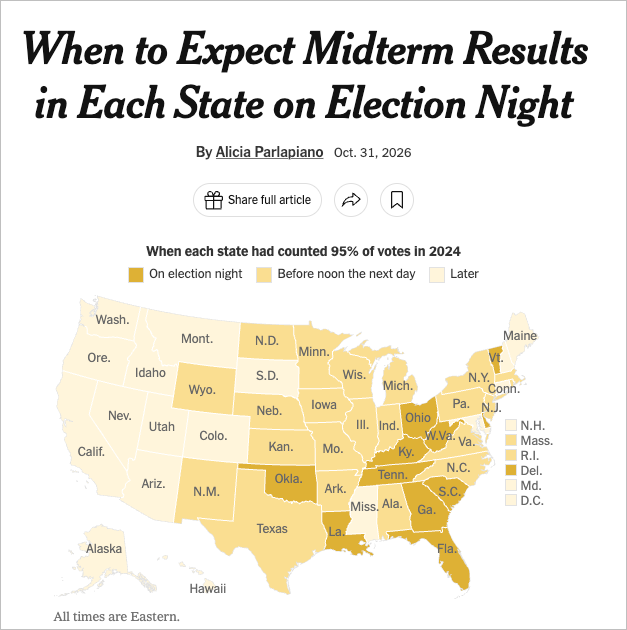
📍 When to Expect Midterm Results in Each State on Election Night - The New York Times 🎁
📍 Your election night cheat sheet - Axios
MIDTERMS
Most of the analysis I’m sharing here is from The Cook Political Report with Amy Walter (I’ll use the shorthand “CPR” below). I’m not usually big on polls, so I don’t typically share them over the course of a race. But this close to the big day, it’s helpful to step back and look at the totality of polling so far.
I use Cook because they are the most cautious in their calls, they’ve been in the business a long time, and it’s a service I pay for — which you may not have access to, so it’s most likely something you haven’t heard yet. There are plenty of free polls you can search and review for further analysis, if you'd like a fuller picture.
I’m not analyzing every race, just the ones that are on the line or could tip the balance of Congress. You may not live in these states, but their outcomes could decide who controls Congress — and that will most likely affect you.
First up, the Senate.
SENATE
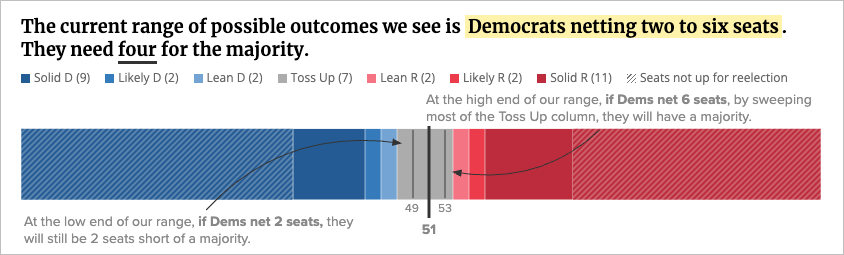
Republicans control the Senate right now, 53-47. (The 47 includes the two independents who caucus with Democrats.)
Thirty-five Senate seats are up for election on Tuesday.
Democrats could net 2-6 seats, according to CPR’s analysis. Democrats need at least four to take control of the Senate. In a 50-50 Senate, Vice President Vance can break the tie, which is why Democrats need at least 51 seats.
What happens if Democrats control the Senate? While legislation can originate in either chamber of Congress, the Senate holds some exclusive powers.
For example, the Senate confirms or rejects presidential nominees, including Supreme Court justices, the president’s Cabinet, ambassadors and high-ranking military officials.
The House can impeach the president or a Cabinet member, but only the Senate can convict. The Senate also has the power to approve or amend treaties.
One seat Democrats are likely to gain is North Carolina’s, currently held by a Republican.
The other gains could come from seven “toss-up” Senate races. All but Maine are in states Trump won in 2024. Here they are, with the 2024 presidential margin in parentheses:
Alaska (Trump +13), Iowa (Trump +13), Kansas (Trump +16), Maine (Harris +7), Michigan (Trump +1), Ohio (Trump +11) and Texas (Trump +14).
Six of the seven are held by Republicans; Michigan is held by a Democrat. Iowa, Michigan and Texas are open seats — meaning no incumbent is on the ballot.
Let’s start with the two races that had significant developments this week.
First, ALASKA.
In last weekend’s newsletter, we discussed how the Trump administration filed a lawsuit preemptively challenging the results of the Alaska Senate race between Republican incumbent Sen. Dan S. Sullivan and Democrat Mary Peltola.
In that lawsuit, the DOJ asked a federal judge to “bar” Alaska from certifying the race if Sen. Sullivan were to lose by a “margin less than the number of votes” received by a man named Dan J. Sullivan, Jr., who is also on the ballot. The DOJ alleged that the other Sullivan was running to confuse people into voting for him instead of Sen. Sullivan.
On Wednesday, The New York Times reported that Peltola’s campaign worked with the Democratic Senatorial Campaign Committee (DSCC) to recruit someone — anyone — named Dan Sullivan to run against Sen. Sullivan. The source: Peltola’s recently fired campaign manager, Elisa Rios.
Rios spoke to the Times on the record but later tried to withdraw her statements. The Times says it corroborated her account with documents and text messages.
Peltola denied knowing anything about the scheme.
The DOJ is conducting federal criminal and civil investigations into the matter, but investigators can’t point to any law that was broken. The state’s Republican governor, Mike Dunleavy, and state officials are conducting similar probes.
The practice — while manipulative, and not unprecedented — is not illegal on its own. “Simply possessing the same name as a candidate is constitutionally protected under ballot access rules,” CNN reports. “Criminality occurs when operatives cross into falsifying residency documents, laundering campaign funds or offering direct payments in exchange for filing.” There is no evidence that Peltola’s campaign or the DSCC did any of this.
“Recruiting a spoiler candidate isn’t against the law unless accompanied by some other violation, such as lying to a court or offering a bribe to a candidate,” the Alaska Beacon reports.
CPR: “Republicans sound pessimistic about this race, given Sullivan’s poor approval ratings — but Alaska is another state that’s notoriously hard to poll. If this race goes to ranked choice voting, as we expect, the outcome won’t be known for weeks.”
Ah, what's ranked-choice voting, you ask? Voters rank the candidates: first choice, second choice and so on. Maine also does this.
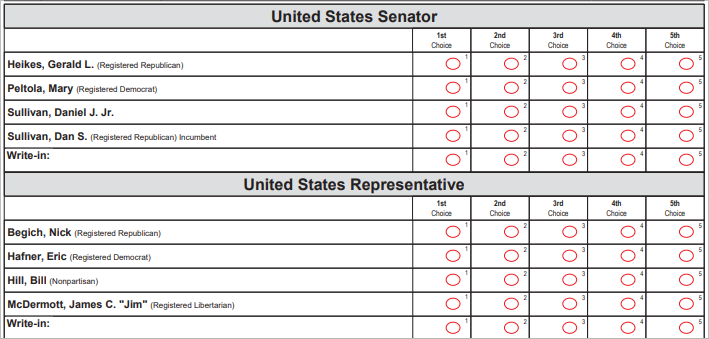
If a candidate gets a majority — more than 50% — of the first-choice votes, they win. If no one does, there’s an instant runoff.
Let’s say Candidate X gets the fewest first-choice votes. That candidate is eliminated.
If I voted for Candidate X as my first choice and Candidate Y as my second, my vote now counts toward Candidate Y. This way, my vote still counts even though my first choice didn’t make it.
If I didn’t pick a second choice, there is nothing to transfer.
This repeats until someone has more than 50% of the remaining votes and wins the race.
Alaska has voted this way since 2022. And there’s a ballot referendum this year asking Alaskans whether they want to keep it.
Next, MICHIGAN.
This is an open seat. The incumbent, Sen. Gary Peters (D), is not seeking reelection.
Democrat Abdul El-Sayed is running against Republican Mike Rogers.
Bigoted attacks against El-Sayed reached a new level this week, with our country’s leaders at the highest levels implying he’s dangerous simply because he’s Muslim or Arab, or both.
- Vice President JD Vance warned against electing someone like El-Sayed, who he claimed has “zero attachments to its land or to its history.” Vance forgets his in-laws are Indian immigrants, his own kids are half-Indian and El-Sayed was born in the US. Video
- At a rally for El-Sayed’s opponent, Trump called him a “jihadist” and said he “would be the only senator that will have to go through a metal detector” to work in the Capitol. “If Abdul and the Democrats win, they will open the floodgates and invite hordes of jihadists to our shores, creating a nightmare of violence and terror until you cannot even have a Christmas,” Trump said. Video
- Sen. Ted Cruz fear-mongered some more, claiming Americans will die if El-Sayed wins. Video
- Ohio Sen. Bernie Moreno said we can’t elect someone like El-Sayed who doesn’t accept that “Jesus came here for our salvation.” Video
- HHS Secretary Robert F. Kennedy, Jr., claimed in a racist tirade at a campaign rally for Rogers that Arabs don’t contribute to society, implying they’re not worthy of public office. AP fact-check here and video here.
Democrats haven't united behind El-Sayed either.
El-Sayed and his former primary rival, fellow Democrat Rep. Haley Stevens, were supposed to campaign together in the final days of the race. Instead, El-Sayed’s campaign told Stevens to “stay away from all future campaign events in the closing days of the race,” Politico reports.That happened “after Stevens released a lengthy statement calling on El-Sayed to shift his rhetoric on Israel and more forcefully disavow a commercial made by someone else,” The Washington Post reports. The ad blamed high grocery and gas prices on US support of Israel. Critics slammed it as antisemitic. El-Sayed later said he didn’t approve of its contents.
On Sunday, Stevens endorsed Rogers and attended a church service with him, after which she told reporters, with a straight face: “I’m not turning my back on Democrats. It is this one vote.”
here's the entirety of the seeming mental breakdown Haley Stevens just had on CNN. One of the most bizarre and incoherent political interviews I can recall. Note how she's completely unable to explain why she changed her mind from supporting Abdul El-Sayed last night to endorsing Mike Rogers today.
— Aaron Rupar (@atrupar) November 2, 2026
This race just gets more unhinged as the hours go by...
Michigan’s Senate race is probably one of the most important in the country — not just because it can help Democrats tip the Senate in their favor, but because what happens here on Tuesday will have implications far beyond 2026.
- If Democrat Dr. Abdul El-Sayed wins, he’ll be the first Muslim-American elected to the Senate. If Republican Mike Rogers wins, he’ll be the first Republican elected to the Senate from Michigan since 1994. Either outcome will change how Michigan, a key swing state, is represented in the Senate — and offer a measure of where its voters see the state, and the country, heading.
- If he wins, El-Sayed becomes a problem for Republicans far beyond 2026. Remember, Barack Obama was a first-term senator when he ran for president — and won. He was a charismatic, progressive newcomer with a name Republicans tried to make sound foreign. His rise still haunts them. El-Sayed fits that mold. He’s often compared to New York City Mayor Zohran Mamdani — both young, likable, anti-genocide, and targets of anti-Muslim bigotry. But Mamdani was born in Uganda and can never be president. El-Sayed was born in the US. He can. Red Alert! Stopping El-Sayed on Tuesday means stopping the next Obama, and, as Sen. Moreno made clear, an existential threat to their brand of white, Christian nationalism. If El-Sayed can win in spite of all this... well, Republicans should damn well be scared.
HOUSE
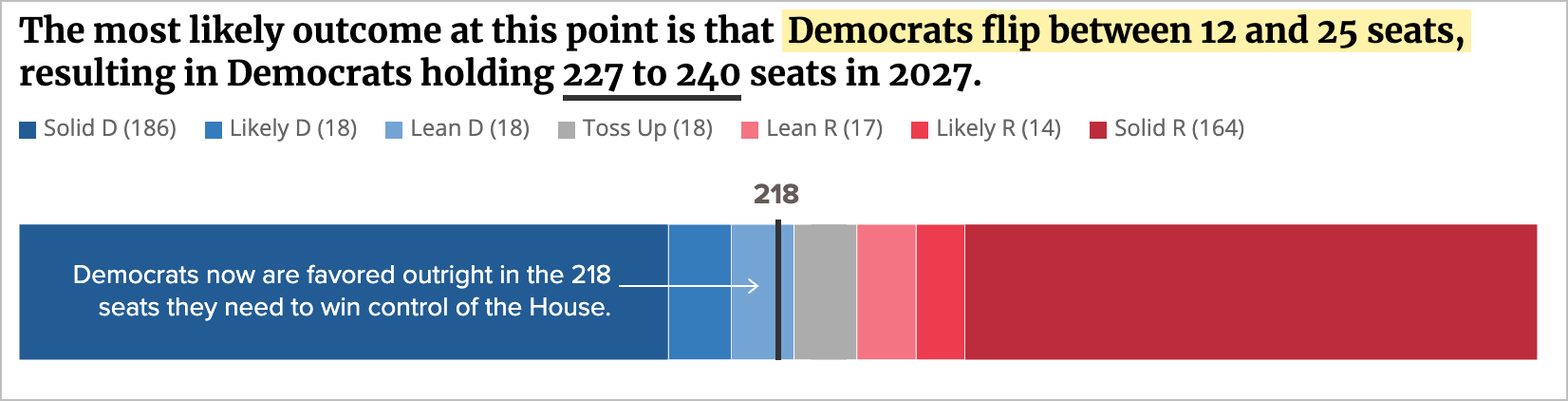
CPR estimates that Democrats could pick up between 12 and 25 House seats. Among the factors CPR cites: “President Donald Trump’s approval rating is underwater even in deep red seats that he won comfortably in 2024, and heavy spending from Republicans doesn’t appear to be moving the needle.”
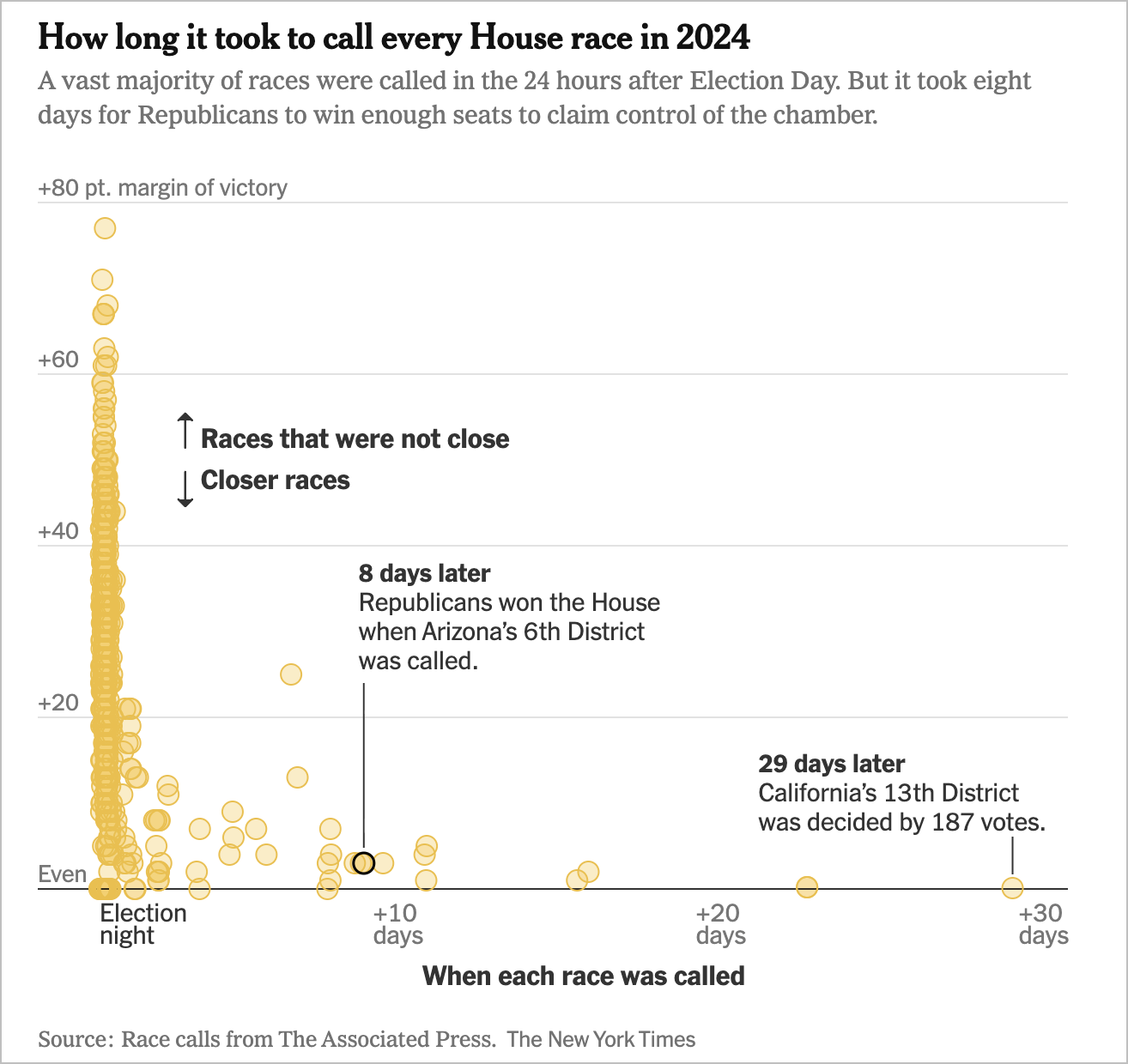
The Trump administration is heavily focused on CALIFORNIA.
In the October 18th issue of The Fifth, we discussed how the DOJ was suing California and threatening local election officials there with criminal prosecution unless they complied with demands that could have disenfranchised thousands of voters in the state.
The DOJ had given California a list of 20,000 names, alleging those people were noncitizens who had requested mail-in ballots. The DOJ sued the state, demanding that it set aside those voters’ ballots — if cast — until their citizenship could be verified.
On Wednesday, federal Judge David Carter ruled against the DOJ, writing that its request “would wreak havoc and disrupt the election that is already underway, create a chilling effect on election workers and voters alike, and discount the votes of United States citizens.”
He added: “Eroded trust in our democracy is irreparable. Once a vote is segregated, lasting harm has occurred. If the Executive can discount votes and threaten an ongoing election due to unproven allegations, then our democracy is in danger. This Court declines to be a party to such process.”
The DOJ appealed. On Friday, a federal appeals court ruled 2-1 against the DOJ. The majority wrote: “As the district court found — and we discern no clear error — there is no feasible way to identify and segregate the ballots of specific individuals without potentially catastrophic effects on the entire system.”
It’s unclear what the DOJ will do now.
Meanwhile, an immigrant rights group says that more than 4 in 10 names on that list aren't even on California's voter rolls, the AP reports.
Also in California, labor unions sued the DOJ, asking a federal judge to bar it from intimidating election workers. Judge Trina Thompson issued a temporary restraining order blocking the DOJ from doing so — before the DOJ even had a chance to weigh in. She wrote: “Ballots have already been issued. Americans have already begun voting. Workers have already begun processing ballots. Given the consequences of inaction, the Court sees no reason to delay its ruling.”
“Although Defendants claim that their actions are designed to halt unlawful voting by noncitizens, their actions are likely to have the effect of interfering with election administration and disenfranchising lawful voters.”
The judge outlined what this means in practice for state and local officials. The DOJ:
- cannot threaten or intimidate them into stopping the processing of any ballots just because the DOJ claims certain people are not eligible to vote.
- cannot demand that people be removed from voter rolls or refused ballots, or that certain ballots be segregated.
- cannot threaten them with criminal prosecution if they don’t comply with DOJ demands.
- must notify every state or local official it sent letters threatening prosecution that those letters have been “enjoined” (blocked by the court).
- must tell the court where it has pending search warrants, subpoenas or plans to access election materials or ballots related to people it claims are ineligible to vote.
The government has until Monday to respond.
Also in California, Reuters reports that the Trump administration has deployed federal immigration agents to agricultural areas to hunt for alleged noncitizens — raids that have sparked accusations of voter intimidation.
“Unlike past operations in big cities like Minneapolis and Chicago that put hundreds of armed, masked agents on the streets, the surge here has been characterized by small groups of officers moving from town to town in the largely agricultural region. The United Farm Workers union said it knew of hundreds of California farmworkers detained in recent weeks.”
The agents are focused on areas with key House races. In Bakersfield, for example — in California’s 22nd congressional district, where Democrat Randy Villegas holds a slight lead over Republican Rep. David Valadao — “immigration arrests jumped from one a day for much of the year to nearly 10 per day in mid-October,” Reuters reports, citing preliminary DHS data.
“‘By all metrics, this should be a very close district,’ said Thad Kousser, co-director of UC San Diego’s Center for Transparent and Trusted Elections. ‘Anything that drives voters to or away from the polls could matter.’”
“Maribel Ramirez, a local farmworker, said the arrests have had a chilling effect on political activity in the area. She said that some young Hispanics with US citizenship have told her they are scared to vote, fearing it could expose the addresses of family members without legal status.”
TURNOUT

- More than 53 million votes have already been cast in early voting, according to the University of Florida’s Election Lab. That’s nearly 7 million more early votes than at the same point in 2022.
- “Advance voting has also increased more than 30% from the same point four years ago in Maine, Michigan, North Carolina and Kansas, states with competitive Senate races. In South Carolina, where voters are choosing a successor to the late Republican Sen. Lindsey Graham, early voting is up 83%,” the AP reports.
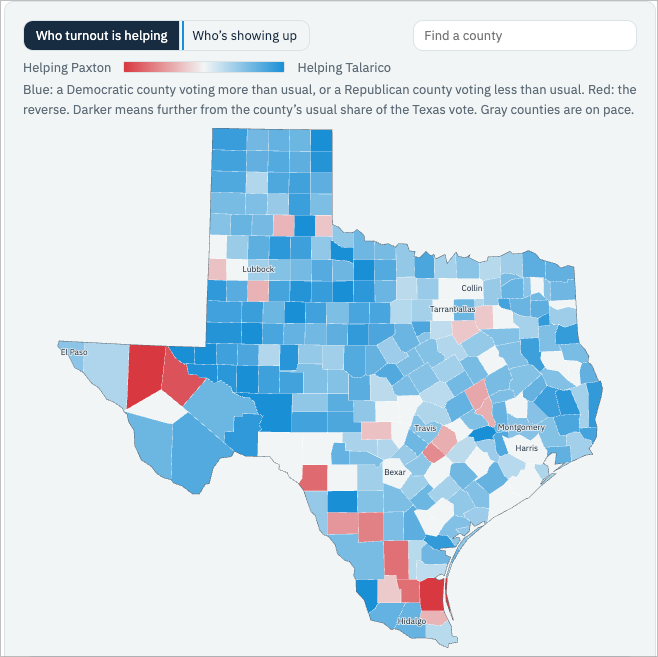
- In TEXAS, early voting turnout has hit a record high for a midterm election. An estimated 7.4 million people have voted early so far — nearly 39% of registered voters. The previous record was in 2018, when nearly 38% voted early; early votes made up more than 71% of all ballots cast that year (nearly 6 million). In 2022 — the last midterms — early voting turnout was just over 31%, per KXAN.
- Could high turnout in Texas be a sign of more Democrats voting than Republicans? The Washington Post: “Republican lawmakers are confronting an enthusiasm gap nationally due to the unpopularity of President Donald Trump, wars, data centers, and high gas and grocery prices. Nowhere is the fallout more visible than in Texas, where Trump held Republicans’ midterm convention last month and visited several times this month to rally support. Republicans have controlled every lever of state government for generations by winning rural counties and significant margins in suburban and urban areas where most voters live. But early turnout shows Democrats — led by Attorney General Ken Paxton’s opponent, state Rep. James Talarico — doing the reverse. Turnout for Democrats has increased in urban areas, and Democrats have posted gains even in conservative rural counties, according to nonpartisan voting analyst Steven David.” (If you’re interested in Texas numbers, check out David’s website here.) Texas hasn’t elected a Democratic senator since 1988.
- On election night, watch Texas Gov. Greg Abbott’s (R) numbers. In 2022, Abbott beat Beto O’Rourke (D) — considered a strong contender — by nearly 11 points. The AP called that race at 10:56 pm ET on election night. If the Senate race hasn’t been called by then but Abbott has won, his margin could give us clues about whether Talarico has a chance. CPR reports that “some GOP strategists are hopeful that if Abbott can win by five points or more, he’ll pull Paxton over the finish line. If Abbott barely wins, though, Texas could finally turn blue.”
- “'Underperformance is rarely isolated,' said Jason Thielman, who ran the National Republican Senatorial Committee as executive director during the 2024 cycle. 'If you see the GOP underperforming early in the East, it is likely going to continue as you move further West.'” Axios
RELATED:
- A “bad actor” tried to breach the Federal Election Commission’s systems last Monday night, forcing the agency to shut down its electronic filing system and cutting off campaign finance disclosures a week before the election, Reuters reports.
- As early voting surges, Trump reshuffled his schedule to add back rallies in Iowa and Kansas PBS
- House Speaker Mike Johnson tells CNN that if Democrats win, “We are going to follow the law,” and calls concerns that he won’t a “nonsense narrative that are Democrats are making up...”
- Pope Leo XIV — the first American pontiff — is, naturally, the first pope to vote in a US general election. He cast an absentee ballot in Illinois, his home state, the Vatican said.
Headlines
- Sen. Chris Murphy — who suffered a stroke this weekend and is expected to recover — said earlier this week that he was briefed by the Pentagon on its possible post-election war plans for Iran, and called them “insane.” Murphy said he can’t disclose more but suggested recent reporting on the war plans may be what he’s alluding to. The Wall Street Journal reported this week that the US is warning Gulf countries to get ready for a short but intense military campaign in the region. “The communications through diplomatic and military channels are among a growing number of indications that the U.S. and Israel are readying to launch a new round of heavy combat operations against Iran, risking a major escalation in hopes of degrading Tehran’s strength and pushing it toward negotiations.”
- Tucker Carlson reports that Israeli Prime Minister Benjamin Netanyahu is pressuring Trump to launch an imminent nuclear strike on Iran.
- Defense Secretary Pete Hegseth fired Army Lt. Gen. Brett Sylvia, the military’s top long-term planner, after accusing him of leaking intel to reporters about the wars in Ukraine and Iran. Axios reports that Sylvia admitted to it after failing four polygraph tests. The Pentagon has referred him for criminal prosecution, The Washington Post reports. Sylvia hasn’t commented publicly. Hegseth has fired a long string of top military leaders, including the last guy who had Sylvia’s job.
- Soldiers practiced temporary battlefield burials for the first time in decades, the Army reports. “The exercise served as a critical test of concept to validate the feasibility of battlefield temporary interment, an operational reality the U.S. Army has not executed at scale since the Korean War.”
- Israel’s election is still deadlocked after no party or bloc won enough seats for a majority. “What’s ahead is likely weeks of political wrangling as Israel’s disparate factions weigh possible governing arrangements, including a unity government bringing rival factions together or a minority government reliant on outside support. If they fail to reach an agreement, Israel could head back to the polls,” Al Jazeera reports.
- A new report by House Democrats details new allegations by Beatrice Keul, who says Trump raped her in 1993. Four other women have also accused Trump of rape. Democrats want the DOJ to appoint a special counsel to investigate Trump.