Chaos & Casualties: Trump and Netanyahu’s War on the Middle East Rages
Two weeks in, there are more questions than answers. And civilians are paying the price of a war with no purpose
Every week, The Fifth scores the biggest stories on power, democracy, and accountability — so you know what to pay attention to and what you can let go. Here are this week's top stories:
#1 Iran: No Strategy, No Endgame (New)
In mid-February, The Intercept reported that three U.S. officials said they did not think the Trump administration "had anything but vague plans to deal" with the consequences of waging war on Iran. Still, the Trump administration moved two U.S. aircraft carriers into the region, along with thousands of troops. Days later, the U.S. illegally attacked the country. Those warnings were spot on. In the last week, the Trump administration has shown it grossly underestimated Iran, ignored its own military advisers, failed to prepare, and had no plan to protect Americans.
- Wrong bet. In January, The Wall Street Journal reported that Trump's advisors told him that an attack was "unlikely" to collapse Iran's regime and could "spark a wider conflict." They were right. After assassinating Iran's Supreme Leader Ali Khamenei on February 28, intelligence sources told Reuters that Iran’s leadership was still intact and not at risk of collapsing. On Wednesday, Iran's Assembly of Experts chose his son, Mojtaba Khamenei, as his successor.
- Khamenei Redux. The new leader issued a written statement – read aloud on state media – vowing revenge against the US. Defense Secretary Pete Hegseth told reporters the new supreme leader is "wounded and likely disfigured" from the strikes that killed his father — but offered no evidence. It's also possible Khamenei may not have appeared in public due to security concerns.
- Warned and ignored. Gen. Dan Caine, chairman of the Joint Chiefs, had warned Trump before the war that a campaign against Iran risked entanglement and American casualties, and that a lack of munitions and allied support could put U.S. troops in greater danger. But, Trump responded on Truth Social claiming that Caine actually thought the war would "be something easily won." Not so.
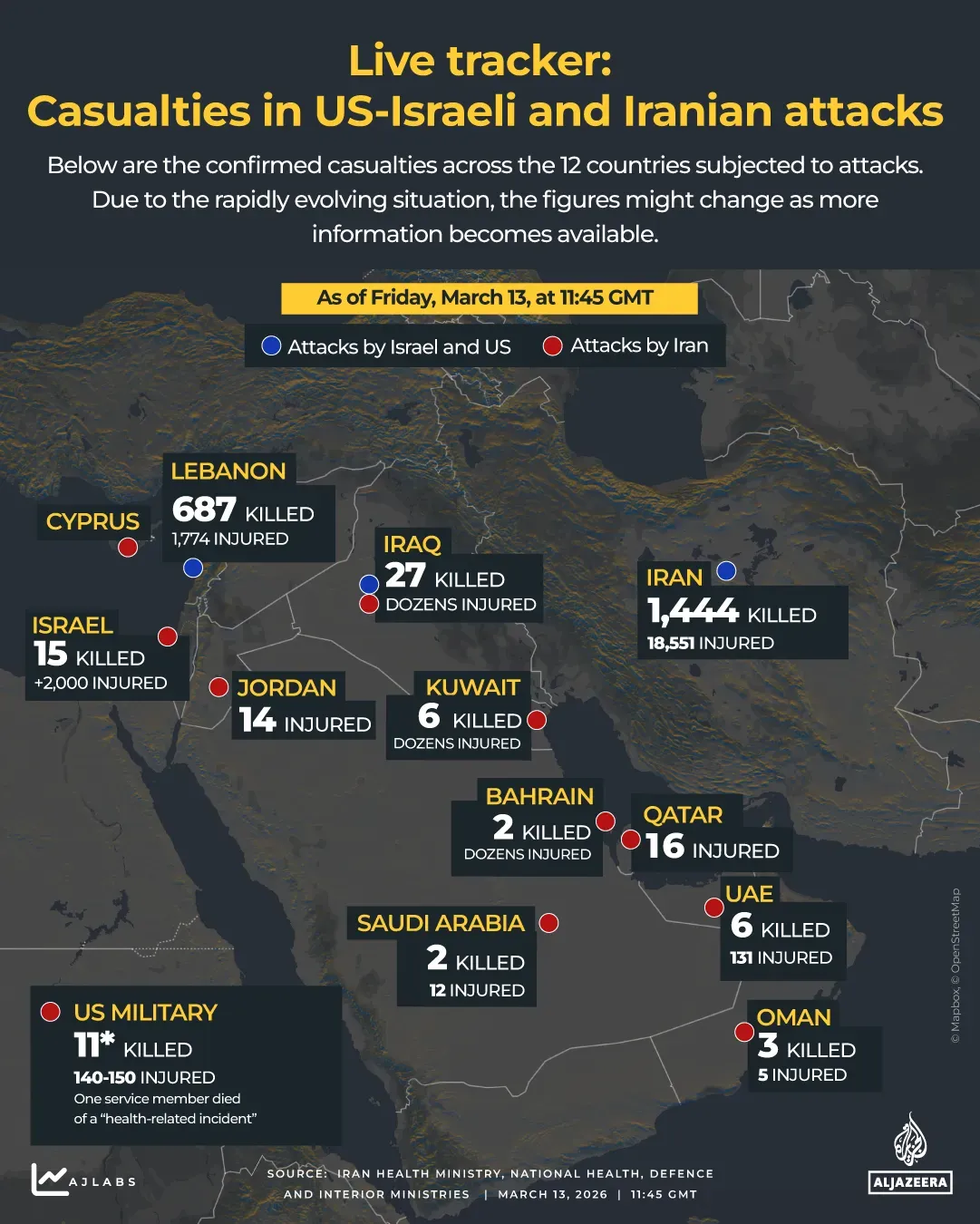
- Sitting ducks. At least 13 U.S. service members have been killed. Six died in the early hours of the war after an Iranian drone strike on a "makeshift" operations center at Port Shuaiba, Kuwait, that was still being set up. There was no warning system, CNN reported. Officials told CBS News that the structure was not fortified — despite Defense Secretary Pete Hegseth's claims to the contrary. This week, CBS News also reported that dozens more were injured in that attack, more severely than previously known. At least 30 remained hospitalized with serious injuries including brain trauma, burns, and one service member who may require a limb amputation. Another soldier was killed in Saudi Arabia. This week, six more died when their refueling jet crashed in Iraq. The Pentagon said it was not caused by enemy fire.
- Drone gap. Iran's strategy relies heavily on cheap but sophisticated drones known as Shaheds — the same type used to kill the troops in Kuwait. The drones are hard to spot and difficult to defeat without expensive interceptors, spreading U.S. forces thin. The Pentagon says it is working to develop its own counter-drone systems, but they're not ready. They could have been.
- Paying the price. This week, we learned that last August, Ukrainian President Volodymyr Zelenskyy offered to help the U.S. counter the drones based on his country's nearly four years of experience fighting them against Russia, which acquired the technology from Iran. Axios reported that the Ukrainians even made a PowerPoint warning U.S. officials that Iran was improving its Shahed drone design. The Trump administration passed. "'If there's a tactical error or a mistake we made leading up to this [war in Iran], this was it,' a U.S. official acknowledged." The Shahed drones have killed US personnel, destroyed assets in the region, and cost the US billions in defense.
- Stranded abroad. While Trump's advisers seem to have warned him about the serious consequences, no one seemed to think of US personnel already in the region. Ten days into the war, U.S. government employees stationed across the region could not be safely evacuated, ABC News reported. Diplomatic missions across the Middle East were given little warning before the strikes, and even as conditions in countries like Iraq deteriorated rapidly, days passed before evacuation orders were formally issued. During this time, three security guards were injured after a U.S. support facility was hit by a drone strike in Baghdad.
- Allies blindsided, too. The U.S. has at least 19 bases and military facilities across more than 10 Middle Eastern countries — all of which have been hit by Iranian retaliatory strikes. Some of those countries told the AP that the U.S. did not warn them before it attacked Iran. They said they were "frustrated and even angry" that the U.S. was not defending them enough, with one official saying "the operation has focused on defending Israel and American troops, while leaving Gulf countries to protect themselves."
- More. Two more consequences of being unprepared — the Strait of Hormuz crisis (#4) and the Minab school strike (#2) — are covered separately below, but both trace back to the same failure: an administration that launched a war without planning for what would happen next.
📌 Robbing Peter. The Pentagon is sending reinforcements — 2,500 Marines aboard the USS Tripoli Expeditionary Strike Group, including F-35 fighter jets, a guided-missile cruiser, and a destroyer. The problem: they're being pulled from the Philippine Sea, where they were stationed near Taiwan. The U.S. is weakening its Pacific posture to backfill a war it didn't staff for.
📌 No quarter. On Thursday, Defense Secretary Hegseth told reporters there would be "no quarter, no mercy" for Iranian forces. "No quarter" means killing combatants even if they surrender — a war crime under the Hague Convention, the Geneva Conventions, and the U.S. War Crimes Act of 1996. The mere declaration of it by a government official can itself constitute a violation.
📌 Double trouble. Russia has been providing Iran with intelligence on the locations and movements of American troops, ships, and aircraft, CNN reported — meaning Iran's Shaheds are more effective because Iran knows where to aim.
📌 We still don’t have answers about why we went to war to begin with.
📌 CNN: Russia is giving Iran specific advice on drone tactics, Western intelligence source
📌 The New Republic: Trump Says He Knows Where Iran Sleeper Cells Are—But Won’t Arrest Them