Gerrymandering, punishing Cubans, and Trump's latest grift
America has come full circle after 250 years, thanks to King Trump and his Republican court


#1. How to Dismantle a Democracy: Election Interference
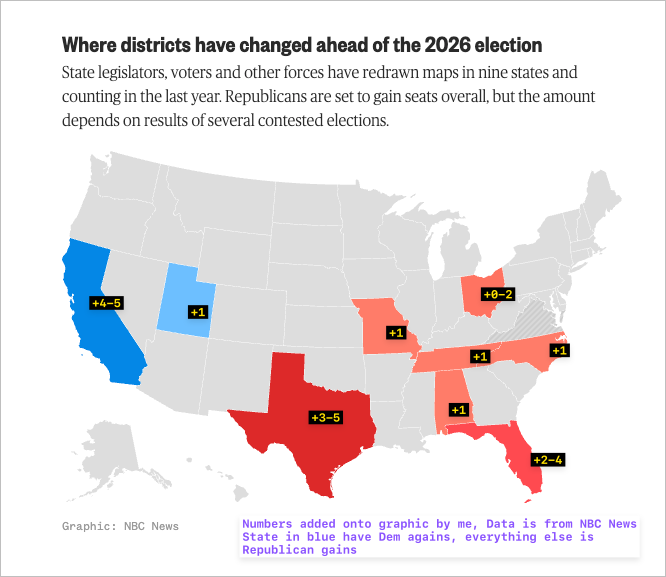
Republicans are laser-focused on gerrymandering the maps of states they control. The goal is to lock in the House majority before voters get the chance to take it from them in November. This week, the fight played out across seven states:
- VIRGINIA (Primary date, August 4): In a major loss for Democrats, the Supreme Court declined to overturn a Virginia Supreme Court order blocking the use of a congressional map voters approved last month. SCOTUS link
- Democrats appealed to the Supreme Court after Virginia's high court blocked the new map, ruling it violated procedural rules when it was passed. The map would have helped Democrats win four additional House seats in November and level the playing field against Republicans gerrymandering their maps to win more seats.
- The Washington Post writes that "independent observers and members of both parties believe one or more seats in the state could flip from red to blue, given President Donald Trump's low approval ratings, historical trends and some factors specific to the state's candidates and districts."
- ALABAMA (May 19): The Supreme Court on Monday threw out a lower court ruling requiring Alabama to use a 2023 congressional map drawn to comply with Section 2 of the Voting Rights Act. That map, used in the 2024 elections, includes two majority-Black districts. The older map — which Alabama had previously been barred from using — includes just one. With the Supreme Court's order, Alabama can now hold its May 19 primary using the older map. A lower court has a hearing scheduled for May 22 to revisit the case — three days after the primary.
- SOUTH CAROLINA (June 9): Things initially looked promising for Democrats in South Carolina after five Republican state senators voted against a measure that would have opened the door to new gerrymandering before this year's primary. Senate Majority Leader Shane Massey, one of the Republicans who voted no, said he had "too much southern blood" in him "to surrender" to Trump's pressure. But Gov. Henry McMaster showed he has none.
- After suggesting publicly that he was unlikely to override lawmakers and call a special session to redraw the maps, McMaster reversed course Friday night. He later denied reports that he changed position after pressure from Trump, who has endorsed his Lt. Gov. Pamela Evette for governor. Evette is running against Rep. Nancy Mace, who had criticized McMaster for not originally calling a special session.
- South Carolina Republicans are trying to push out the state's sole Black Democratic congressman, Rep. James Clyburn. The state's primary is June 9.
- FLORIDA (August 18): Gov. Ron DeSantis's congressional map is facing a lawsuit alleging it violates the state constitution's ban on partisan gerrymandering. The map could give Republicans an additional 2–4 seats in Florida, where they already control 20 of the state's 28 congressional districts.
- MISSOURI (August 4): The Missouri Supreme Court ruled that a congressional map drawn by the state's Republican legislature that shifts the state's delegation from 6–2 to 7–1 can stay in effect and be used in this year's primary even though a referendum petition was filed against it. A referendum petition is a way for citizens to challenge a law the legislature passes by putting it on the ballot for voters to approve or reject. If the petition's signatures are verified and it qualifies, voters will decide on November 3 whether to keep the new map. So that means voters will elect representatives on the gerrymandered map, and could then vote to kill it in November, meaning they'd go back to the old map in two years during the next election.
- TENNESSEE (August 6): There was fallout from the state's newly gerrymandered map: Longtime Rep. Steve Cohen — the state's only Democrat in Congress — announced Friday he is ending his reelection bid after Republicans gerrymandered the map to split his Memphis district into three Republican-leaning districts.
- In Maryland (June 23) and Georgia (May 19), state parties are already looking ahead to 2028:
- Gov. Brian Kemp called on Georgia lawmakers to begin work on redrawing congressional maps ahead of the 2028 election — before Republicans potentially lose control of the state legislature, The New York Times reports.
- After Virginia's loss, Maryland Democrats are revisiting the idea of redrawing their congressional map, NOTUS reports. But it's more likely to happen in 2028, Politico adds.
- And finally: Trump took to Truth Social on Saturday to demand passage of the SAVE Act, claiming Maryland had "500,000 Fake Mail-In Ballots revealed." What actually happened: Maryland's State Board of Elections is reissuing roughly 400,000 mail ballots after a vendor error sent some voters ballots for the wrong party — a logistical mistake, not voter fraud. Trump is pushing Republicans to attach the SAVE Act — which would require proof of citizenship to vote — to the housing and FISA bills currently moving through Congress.
#2. Cuban Crisis
New – "Cuba's Next" listed as "Escalating" on March 29, 2026

Months after the US imposed a blockade on fuel shipments to Cuba, the island nation finally ran out this week, leaving nearly 11 million people without electricity for an estimated 20–22 hours a day. Without fuel, Cubans can't refrigerate food, hospitals struggle to power lifesaving equipment, and in the thick of summer, there's no air conditioning. It was 87 degrees in Havana on Sunday.
Secretary of State Marco Rubio — whose parents immigrated to the US from Cuba — said the administration had offered $100 million in aid for Cuba, to be distributed through the Catholic Church. The irony was not lost on Cuba's Foreign Minister Bruno Rodríguez Parrilla, who called it "incongruous" for the US to offer aid while subjecting Cubans to what he described as "collective punishment through an economic war."
The American blockade was strategic: squeeze the country hard enough to create chaos, deepen public anger, and weaken confidence in Cuba's leadership — while positioning the US as the only way out. The first step in the game plan was to kneecap Venezuela, Cuba's key ally and oil supplier, whose leader Nicolas Maduro was captured by US forces and brought to the US in January.
Now, with Cuba and Cubans exactly where it wants them, CIA Director John Ratcliffe made a rare visit on Thursday to Havana to warn the country's officials to get their act together or risk facing the same fate as Venezuela, The Wall Street Journal reported.
Sitting just 90 miles from Florida – a one hour's plane ride – Cuba is close enough that any government the US views as hostile, unstable, or outside its sphere of influence quickly becomes a target for pressure and control.
The first and second Trump administrations have accused Cuba of harboring terrorists — which Cuban leaders deny. They also claim their campaign is meant to force "meaningful reforms" – whatever that means – to Cuba's communist system.
Or, maybe Trump wants to build a resort there. In March, Trump told reporters: "Cuba, it's a beautiful island. Great weather. I will be having the honor of taking Cuba. Whether I free it, take it. I think I can do anything I want with it, if you want to know the truth."
More broadly, it also reflects a global push by strongmen like China's Xi, Russia's Putin, Israel's Netanyahu, and Trump to assert regional hegemony. It's almost like carving a giant cake into pieces: one large enough to keep each of them satisfied. For now. Cuba is a sprinkle on the American slice.
Whatever the reasons, Cubans have been to this movie before. CNN's Patrick Oppmann writes that "Cubans have lived with the threat of US military action for so long that it has become a dark joke. 'Cuando vienen los americanos' — when the Americans come — is the expression Cubans employ with their trademark black humor to say how a long-running problem — of which there are countless — will one day be resolved. Now it really does look, one way or another, like the Americans are coming."
#3. Trump v. Trump – Government Grift
New

It appears that on the cusp of its 250th birthday, America has come full circle — with another tyrant at its helm, trying to colonize his friends and neighbors.
President Trump is in negotiations to settle his $10 billion lawsuit against the IRS and his $230 million suit against the DOJ. The suit against the IRS claims the agency failed to prevent his tax returns — which he promised to release and then refused — from being leaked by a contractor. The second suit is against the DOJ for daring to investigate him for ties to the Russian government.
The proposed terms: Trump drops the suit in exchange for the government putting $1.776 billion in taxpayer money (a nod to 1776) into a "Truth and Justice Commission" he would use to pay out people (like 1,500 charged in connection to the January 6th Capitol insurrection) he says were wronged by the Biden administration, ABC News reports. The commission would have five members to decide who gets a pay day — would keep decisions and names and dollar amounts secret.
Clearly, the buck doesn’t stop with Trump, it stops at Trump. There’s more detail about the IRS suit in Tuesday’s edition of The Fifth.
We also learned this week that:
- In honor of the country's 250th anniversary, Trump is reportedly considering pardoning 250 people, The Wall Street Journal reports. Last month, the WSJ reported that Trump is also promising pardons to staff — a signal that breaking the law on his behalf may not carry consequences.
- Also, Trump's judgement = not so great. The Guardian headline: "At least five people pardoned by Trump for Capitol attack accused of new crimes."
- The New York Times reported that Trump’s Lincoln Memorial Reflecting Pool renovation which was estimated at $1.8 million and has ballooned to $13.1 million – more than 7x – after a no-bid contract was awarded to Atlantic Industrial Coatings — a firm that has never held a federal contract but had previously worked on the pools at Trump's golf club in Sterling, Va. The White House said the no-bid contract was necessary because "the situation was so urgent that any delay would cause 'serious injury' to the government." Um, ok?
- The Trump Administration might be trying to bypass a public bidding and approval process and get started on building Trump’s 250-foot “arch” by “piggybacking on an existing, unrelated contract for engineering services at the White House grounds more than a mile away, emails obtained by The Washington Post show.”
- The WHO says an Ebola outbreak in Congo is now a “public health emergency of international concern (PHEIC), but does not meet the criteria of pandemic emergency,” according to a post on X. More than 80 people have died and there are more than 245 suspected cases.
- “There are significant uncertainties to the true number of infected persons and geographic spread associated with this event at the present time. In addition, there is limited understanding of the epidemiological links with known or suspected cases," the WHO adds.
- FBI Director Kash Patel has been on thin ice for a while now — even with the Trump administration, and that's saying a lot. This week didn't make it any better.
- MSNOW reports that Patel has been manipulating the FBI's arrest stats to make it look like the bureau is making more arrests — and more violent-crime arrests — than it actually is.
- The AP reports that Patel took a VIP snorkeling tour at Pearl Harbor — the sacred site where 900 sailors and Marines remain entombed.
- Patel — who is suing The Atlantic over a well-sourced article about his drinking and his absences from work — got into it with Sen. Chris Van Hollen (D-MD) over alcohol at a budget hearing. Patel accused Van Hollen of being a lush, claiming the senator had run up a $7,000 bar tab at a DC restaurant. The actual $7,000 charge, per Van Hollen's FEC filing, was for a staff party paid for with campaign funds — not Van Hollen's personal drinking.
- Trump is pulling 4,000 troops scheduled for tours in Poland at the last minute because Poland wouldn't help him with his illegal war on Iran. He's said he'll also pull 5,000 troops from Germany for the same reason.
- Transportation Secretary Sean Duffy took a road trip across America with his family including nine children – sponsored and paid for by companies that he's in charge of regulating. In at least one case, one company "balked at the ethical implications of seeming to buy access" to Duffy, Politico reports.
- Whoops! The Senate parliamentarian has ruled that Republicans can't try to pass $1 billion in funds for Trump's ballroom in an immigration enforcement bill. Doesn't mean they won't keep trying. Senate Majority Leader John Thune's communications director tweeted: "Redraft. Refine. Resubmit."
- The US and Iran are still calling whatever they're doing a "ceasefire" while negotiations to end the war are stalled. The two sides remain far apart: Iran is still calling for war reparations, sovereignty over the Strait of Hormuz, and an end to sanctions. Trump, meanwhile, just screams "TOTALLY UNACCEPTABLE" from time to time, and the whole world looks up and then goes back to whatever it was doing.
- FDA Commissioner Marty Makary is out after a clash with Trump and HHS Sec. Robert F. Kennedy Jr. over approving fruit-flavored vaping products. Makary had been reluctant, citing studies showing they harm kids, and eventually approved them under pressure. Shortly after, Kennedy spokesperson Rich Danker also resigned saying the approval undermined the administration's own warnings that the products "appeal to children and expose them to nicotine addiction, lung damage, and higher risk of cancer."
- The Supreme Court ruled that mifepristone, a drug commonly used in abortions, can be mailed by health providers while a Louisiana case plays out in court. Louisiana sued, claiming the practice violates its state abortion laws.
- A Canadian on board the MV Hondius cruise ship which was plagued with a hantavirus outbreak has tested positive for the illness. Their spouse is experiencing symptoms. So far, none of the 18 Americans aboard the ship have tested positive and are all in quarntine. Colorado says one person has died from the virus — but say it was unrelated to the cruise ship.